

Table of Contents
- Why Baking With Toddlers Builds Fine Motor Skills
- Toddler Baking Activities That Develop Motor Skills
- Baking Activities by Age: From 18 Months to 3 Years
- Easy Baking Recipes for Toddlers
- Safety, Choking Hazards, and Making Baking Mess-Free
- How to Encourage Independence Without Taking Over
- Frequently Asked Questions
Last Updated: October 10, 2026
Why Baking With Toddlers Builds Fine Motor Skills
Baking with toddlers to build fine motor skills is one of the most effective, and delicious, ways to support early childhood development. 🍪 When your toddler scoops flour, squeezes dough, or sprinkles toppings, they're not just having fun. They're building hand strength, coordination, and the precise finger control they'll need for writing, self-care, and countless daily tasks.
Hand Strength, Dexterity, and Coordination
Hand strength develops when toddlers grip measuring cups, squeeze dough, or press cookie cutters into soft dough. Dexterity improves through pinching sprinkles, spreading frosting, or rolling dough. Coordination develops when your toddler uses both hands to hold a bowl while stirring or reaches across their body to grab an ingredient. These skills develop through play, not drills, your child stays engaged because the reward is tangible: warm cookies they helped make.
Finger Control and Bilateral Coordination
Finger control grows through precise movements like pinching dough into balls or holding a spoon steady while stirring. Bilateral coordination means using both sides of the body together, holding a bowl with one hand while stirring with the other builds neural pathways that support balance and complex movements. Baking demands these skills naturally, with no artificial setup.
Toddler Baking Activities That Develop Motor Skills
Simple baking tasks are the perfect vehicle for motor skill development. Each activity targets different skills while keeping your toddler engaged and proud of their contribution.
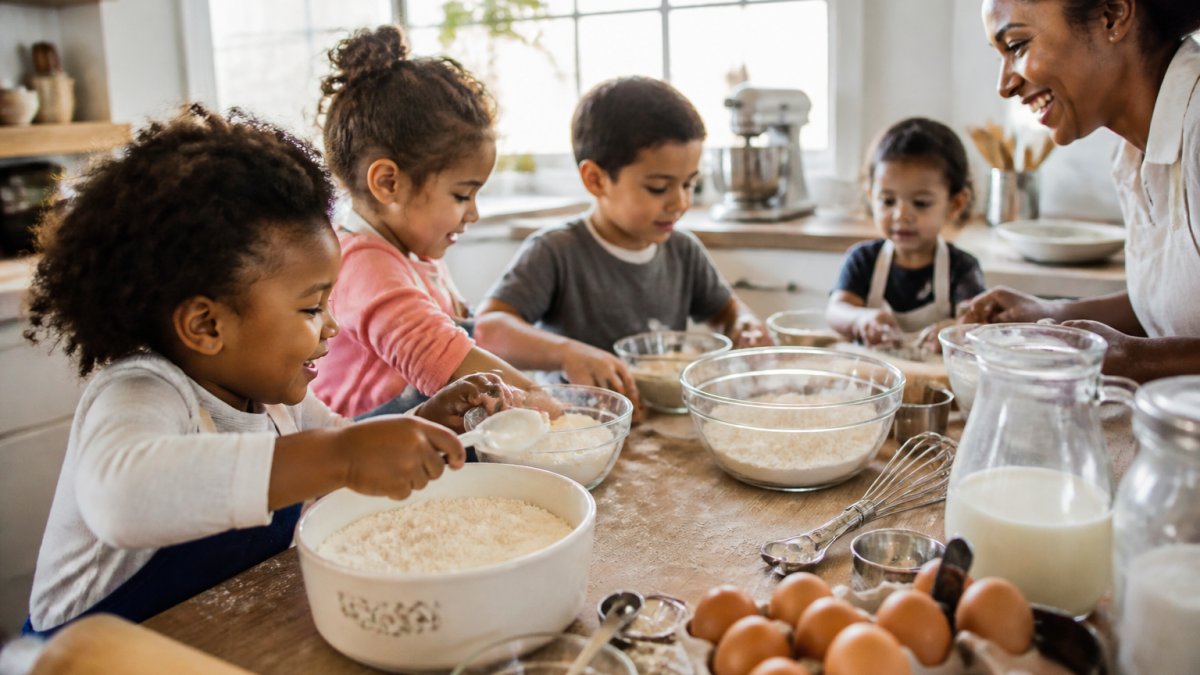
Emerging (ages 18-24 months): Your toddler is still building basic hand control.
- Scoop with a large spoon (low precision needed)
- Squeeze soft dough between their palms
- Drop pre-measured ingredients into a bowl
- Stir with your hand guiding theirs
Developing (ages 2-2.5 years): Your toddler shows more hand control and can follow simple directions.
- Pour from a small container into a larger one (with supervision)
- Pinch and drop toppings onto dough
- Stir independently (though the bowl may move around)
- Roll dough between their palms
Proficient (ages 2.5-3 years): Your toddler has solid hand control and can manage multi-step tasks.
- Measure dry ingredients (with your guidance on leveling off)
- Spread soft ingredients with a butter knife
- Mix ingredients in a bowl while you hold it steady
- Place toppings with intention and care
Watch your child's lead. If they're frustrated, step back to an easier activity. If they're bored, add a small challenge.
Baking Activities by Age: From 18 Months to 3 Years
Motor development follows a predictable progression. Here's what to expect at each stage, and how to support it through baking.
Ages 18-24 Months: Sensory Exploration and Grasping
At this age, your toddler is developing basic hand control and learning to isolate finger movements. Baking is mostly about sensory exploration and learning that their hands can make things happen.
What they can do:
- Grasp a large spoon or wooden spoon with a full hand
- Squeeze soft dough or play dough
- Drop items into a container (large drops, not precise placement)
- Feel and explore dry ingredients (supervised)
Best baking activities:
- Scooping with a large spoon into a bowl
- Squeezing soft dough between both hands
- Dropping pre-measured ingredients one at a time
- Stirring with your hand over theirs, guiding the motion
Why it matters: Simple scooping teaches cause-and-effect and builds awareness of what their hands can do, a foundation for all future fine motor skills.
Ages 2-2.5 Years: Scooping and Pouring
By age 2, your toddler's hand control is improving and they can attempt more complex movements. This is the perfect time to introduce pouring and pinching.
What they can do:
- Pour from a small container into a larger one (with spills)
- Pinch and drop items with more intention
- Stir with increasing independence
- Use a spoon to move ingredients from one bowl to another
Best baking activities:
- Pouring dry ingredients from a small measuring cup into a mixing bowl
- Pinching sprinkles or chocolate chips onto dough
- Stirring dry ingredients together
- Scooping with a measuring cup and pouring into a bowl
Why it matters: Pouring and pinching require hand-eye coordination and control, building blocks for writing and self-care tasks.
Ages 2.5-3 Years: Mixing and Measuring
By age 2.5, your toddler's fine motor skills are noticeably stronger and they can follow multi-step directions. This is when baking becomes a real activity with real contributions.
What they can do:
- Measure dry ingredients with your guidance on leveling
- Stir ingredients together with increasing strength and control
- Spread soft ingredients with a butter knife
- Roll dough into balls
Best baking activities:
- Measuring ingredients into a bowl (you level it off)
- Mixing dry ingredients together
- Rolling dough between their palms
- Spreading frosting or soft dough with a butter knife
- Arranging toppings on cookies before baking
Why it matters: Your toddler can contribute meaningfully to a real recipe and see the connection between their actions and the finished product, building confidence and pride.
Easy Baking Recipes for Toddlers
The best recipes for baking with toddlers are simple and require minimal ingredients. Lura's Kitchen mixes are designed exactly for this, just a few additions and your toddler can help with nearly every step.
Classic Madear’s Old Fashion Teacake Mix →
Simple Teacakes and Chocolate Chip Cookies
The American Academy of Pediatrics recognizes that hands-on activities like cooking support child development across multiple domains, including fine motor skills, cognitive growth, and social-emotional learning.
Madear's Old Fashion Teacakes are perfect for toddlers. The mix requires just a few simple additions, and almost every step invites your toddler to participate.
Why teacakes work for toddlers:
- Soft dough is forgiving
- The mix handles most of the complexity
- Your toddler can scoop, mix, and help shape
- The finished product builds genuine pride
Langston's No-Nonsense Chocolate Chip Cookies are equally toddler-friendly. Simple chocolate chip flavor, straightforward instructions, and room for your child to help at every stage.
Why chocolate chip cookies work for toddlers:
- Pinching chocolate chips onto dough is a perfect fine motor activity
- The dough is sturdy enough to handle
- Mixing and scooping are core toddler-friendly tasks
- The reward is immediate and delicious
Safety, Choking Hazards, and Making Baking Mess-Free
Baking with toddlers requires attention to safety and smart setup. A few precautions make the experience safer and more enjoyable for everyone.
Preventing Choking and Allergy Awareness
Choking hazards include small, hard, or round items. Make sure any toppings are soft or large enough that your toddler can't choke on them.
Safe topping choices:
- Chocolate chips
- Sprinkles (supervise closely)
- Shredded coconut (if your child is 3+)
- Soft cookie pieces or graham cracker crumbs
Allergy awareness: If your toddler has food allergies, keep allergens out of the kitchen and read all ingredient labels. Supervision is non-negotiable, your toddler should never be alone with ingredients or finished baked goods.
Keeping the Kitchen Clean and Organized
Baking with toddlers is messy. That's part of the fun. But smart setup keeps the mess manageable.
Mess-management strategies:
- Use a large, shallow baking sheet under mixing bowls to catch spills
- Place a towel under bowls to absorb splashes
- Wear aprons
- Keep wet wipes nearby for quick hand cleanups
- Use child-height surfaces or sturdy step stools
Organization tips:
- Pre-measure dry ingredients into small bowls before starting
- Use lightweight, unbreakable bowls and utensils
- Keep the workspace clear of clutter
- Have a designated "toddler zone" where they work while you supervise
Lura's Kitchen mixes are designed to minimize mess with fewer ingredients and simpler instructions.
How to Encourage Independence Without Taking Over
Use encouraging language. Instead of "You're doing it wrong," try "That spoon is heavy, isn't it?
Offer choices. Let your toddler decide between two toppings or choose which bowl to use.
Know when to help. If your toddler is genuinely frustrated, step in.
The cookies don't have to be perfect. Your toddler doesn't have to do every step alone.
Lura's Kitchen mixes make it simple.
Frequently Asked Questions
What skills does baking develop in toddlers?
Baking develops fine motor skills, hand-eye coordination, hand strength, and dexterity through activities like scooping, pouring, mixing, and spreading. It also builds bilateral coordination (using both hands together), finger control, and confidence in following directions. Measuring ingredients introduces early math and counting skills, while the sensory experience of touching dough, feeling textures, and observing transformations supports cognitive development and problem-solving.
Which baking tasks are appropriate for different toddler ages?
Ages 18-24 months can explore sensory aspects like touching dough and grasping utensils. Ages 2-2.5 years can scoop, pour with guidance, and sprinkle ingredients. Ages 2.5-3 years can stir, mix, measure with help, and knead dough. Match tasks to your toddler's ability rather than strict age, some children advance faster in certain motor skills. Always supervise closely and break activities into short steps to maintain focus and safety.
How can I make baking safer and less messy with a toddler?
Set up a dedicated baking station with a low table or chair, use measuring cups and spoons sized for small hands, and place a mat or newspaper underneath to catch spills. Keep ingredients in shallow bowls rather than bags, use pre-made baking mixes like Lura's Kitchen mixes to reduce the number of components to manage, and have wet cloths nearby for quick cleanup. Establish clear boundaries about what stays in the bowl, and keep choking hazards (like whole nuts) out of reach. Supervise every step and teach your toddler to wash hands before and after.
What are some fun baking activities for toddlers that build fine motor skills?
Try scooping dry mix into a bowl, pouring ingredients with adult guidance, stirring and mixing with a wooden spoon, pinching and sprinkling toppings, rolling dough into balls, kneading dough with both hands, and spreading soft batter or frosting with a butter knife. Using measuring cups and spoons teaches precision and hand control. Baking with easy mixes like Lura's Kitchen teacakes or chocolate chip cookies keeps the focus on motor development rather than complicated ingredient prep, making the experience enjoyable and confidence-building for your child.