
Table of Contents
- Why Specialty Food Retailers Need Plenty of Cookies to Share
- Top Cookie Types for Specialty Food Retail Assortments
- Merchandising Strategies for Plenty of Cookies to Share
- Gourmet Cookie Gifts That Drive Repeat Business
- Premium Cookie Mixes for Retail: A Smart Inventory Choice
- Food Safety Standards and Shelf-Life for Retail Cookies
- Conclusion
- Frequently Asked Questions
Last Updated: September 23, 2026
Why Specialty Food Retailers Need Plenty of Cookies to Share
Cookies are one of the most reliable impulse buys in specialty food retail, and stocking plenty of cookies to share gives shoppers a reason to add one more item at the register. This guide covers the assortment, merchandising, and shelf-life decisions that turn a cookie display into repeat business.
Walk into any well-run specialty food store and watch where hands go first.
Top Cookie Types for Specialty Food Retail Assortments
The strongest assortments balance texture variety, flavor range, and a clear reason to buy now. A shelf of twelve chocolate chip variations isn't variety, it's repetition with different labels.

Soft-Baked vs. Crunchy Textures
Texture is the first decision a cookie shopper makes, often before flavor. Soft-baked and chewy textures dominate modern demand, especially among younger buyers. Crunchy cookies still sell, but perform best in coffee pairings, holiday tins, and gift assortments where durability matters.
A practical split for most retail shelves:
- Chewy and soft-baked for the front-of-store impulse display
- Crisp and crunchy for gift boxes and coffee-adjacent merchandising
- Both in any seasonal collection, so gift buyers can mix textures
Seasonal Collections and Limited Editions
Seasonal collections create urgency and let you test new flavors without committing permanent shelf space. Holiday trays, back-to-school bundles, and summer picnic assortments give shoppers a reason to buy more than they planned, while limited editions reduce decision fatigue by narrowing the choice to what's relevant now.
Merchandising Strategies for Plenty of Cookies to Share
Merchandising is where most specialty retailers leave money on the table. The cookies are good; the presentation isn't doing them any favors. Almost no cookie content online is written for the retailer rather than the shopper, so this section offers tactics a specialty food buyer won't find published elsewhere.
Retail Display and Product Assortment
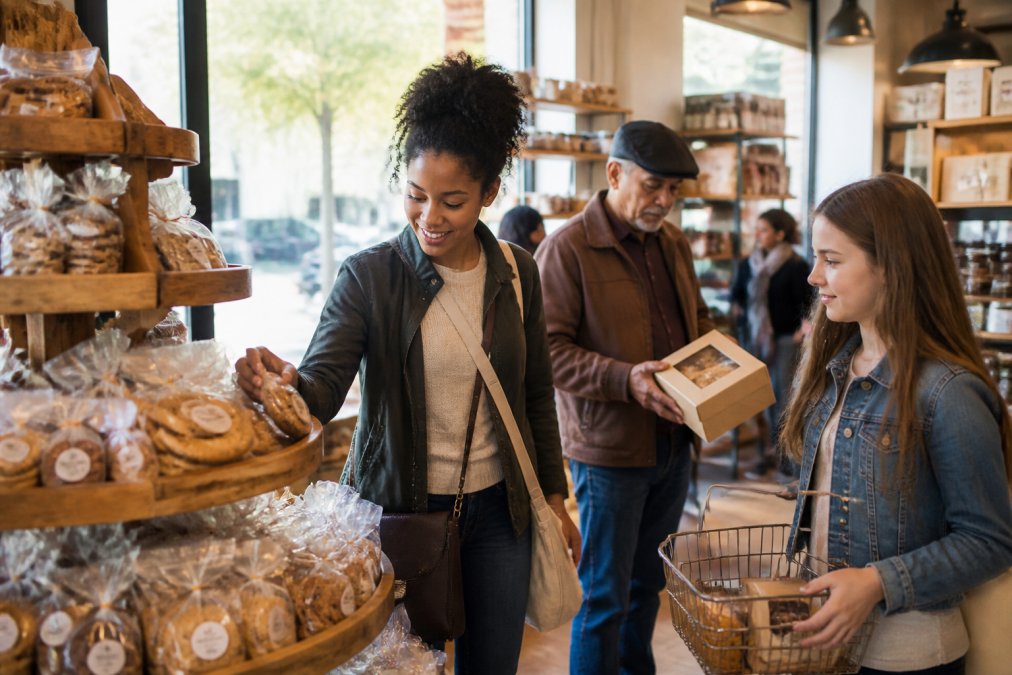
Placement beats persuasion. Cookies belong in at least two locations: a primary display near the entrance or checkout, and a secondary spot near complementary items like coffee, tea, or gift baskets. A few patterns consistently outperform:
-
Eye-level is the money zone. The average adult shopper's gaze lands roughly between 48 and 60 inches off the floor. Put your highest-margin cookie or mix there; reserve top and bottom shelves for backup stock.
-
Tiered and angled fixtures beat flat shelves. A three-tier rack angled toward the aisle lets a shopper see three products at once instead of one.
-
Cross-merchandise with a trigger item. Cookie mixes next to the coffee grinder, or a wrapped teacake beside the tea tins, converts a browsing shopper into a basket builder.
-
Keep the register zone shallow. A single row of individually wrapped cookies works; a deep bin doesn't, because shoppers won't dig while someone waits behind them.
-
Everyday sharing (family-size packs, bulk ordering options)
-
Gifting (individually wrapped cookies, keepsake boxes)
-
Baking at home (premium cookie mixes)
Packaging Aesthetics and Shelf-Life
Packaging aesthetics drive the first look; shelf-life drives the repeat purchase. Clear windows, warm color palettes, and readable labels outperform busy designs, a shopper should identify flavor, format, and occasion from three feet away. Individually wrapped cookies hold up far better on an open display than loose product, and let you sell single units alongside multi-packs, capturing both the quick snack buyer and the party planner.
- Shelf-stable cookie mixes, months of usable shelf life, no refrigeration, ideal for back stock and off-season display.
- Individually wrapped cookies, weeks of display life when kept out of direct sun and away from heat sources.
- Loose or fresh-baked cookies, days, not weeks. These belong up front where they turn fast.
Never stack unwrapped cookies directly on an open shelf without a barrier. Exposure to air and handling shortens freshness and creates a food safety concern that a health inspector will flag. Use tongs, tissue, or a covered case for any unpackaged product.
Photograph your display after every reset. A phone photo taken at shopper eye level shows you what the customer actually sees, and it's the fastest way to catch a dead zone, a blocked label, or a shelf that reads as clutter.
Merchandising isn't decoration. It's the difference between a cookie that sells at full margin and a cookie that gets marked down. Fixture height, cross-merchandising, and a clear shelf-life hierarchy do more for sell-through than any sign ever will.
Gourmet Cookie Gifts That Drive Repeat Business
Gift buyers spend more and return more often than everyday snack buyers. The strongest gourmet cookie gifts share three traits: they look considered, travel well, and feel personal. A keepsake box or ready-to-gift bag does more selling than a plain cellophane sleeve.
Premium Cookie Mixes for Retail: A Smart Inventory Choice
Premium cookie mixes solve the shelf-life problem that fresh-baked cookies create. A mix sits on a shelf for months, ships without refrigeration, and gives the customer a fresh-baked experience at home, a low-risk inventory line for specialty retailers.
| Mix | Flavor Profile | Best For |
|---|---|---|
| Classic Madear's Old Fashion Teacake Mix | Soft, buttery, vanilla and nutmeg | Heritage and holiday baking |
| Langston's No-Nonsense Chocolate Chip | Semisweet chocolate, soft and chewy | Everyday family baking |
| Tura Lura's Chocolate Chip Pecan | Chocolate, buttery Texas pecans | Gifting and celebrations |
Wholesale Pricing Models and Profit Margins
Retailers generally work with one of three wholesale structures: straight wholesale discount, tiered volume pricing, or consignment. Straight wholesale is simplest and protects profit margins best on fast-moving items; tiered pricing rewards larger orders but demands accurate forecasting; consignment shifts risk to the supplier and usually shrinks your margin. For premium cookie mixes for retail, straight wholesale tends to work best because the product doesn't spoil and reorders are predictable.

- Think in turns, not just margin. A mix with a modest margin that sells through four times a season usually beats a high-margin item that sits for six months. Ask the supplier for a realistic sell-through estimate and compare it to your category history.
- Know your keystone. Many specialty food retailers aim for a rough keystone, roughly double the wholesale cost at full retail, on shelf-stable grocery. If a supplier's wholesale price doesn't leave room, the item must earn its place through volume or basket-building.
- Separate the opening order from the reorder. Opening orders often carry a first-time discount or free freight. The number that matters for your P&L is the reorder price.
- Watch the minimum order quantity. A low per-unit price means nothing if the MOQ ties up cash in inventory you can't move in a season.
- Ask about case pack and shelf footprint. A case that fits your existing shelf depth costs nothing extra; one that requires a new fixture is a hidden cost.
- Estimate units you'll realistically sell in the first 90 days.
- Multiply by your target retail price to get projected revenue.
- Subtract wholesale cost, freight, and any slotting or display costs.
- Divide by the shelf space the item occupies to get revenue per linear foot.
- Compare that number to the item you'd have to remove to make room.
Ask suppliers for a sample case and a co-op display allowance before you commit to a full opening order. A small test in one store, measured over 60 to 90 days, tells you more than any sell sheet.
Mixes give you the margin stability of a shelf-stable product with the emotional pull of fresh-baked cookies. That combination is hard to beat in specialty retail, but only if you evaluate the deal on turns, reorder price, and revenue per linear foot, not on the opening-order discount alone.
Food Safety Standards and Shelf-Life for Retail Cookies
Food safety in cookie retail comes down to three controls: proper labeling, correct storage, and clean handling. Shelf-stable mixes and individually wrapped cookies are the easiest categories to keep compliant because they limit direct contact and exposure.
Conclusion
The hardest part of cookie retail isn't finding good cookies. It's building a display that moves them before they lose their edge, and an assortment that brings shoppers back for the next occasion.
Frequently Asked Questions
What are the most popular cookie types for specialty food retail?
Soft-baked chocolate chip, chewy pecan, and old-fashioned teacakes consistently rank among the top sellers in specialty food retail. These varieties appeal to customers seeking gourmet cookies with a homemade feel. Many retailers also stock seasonal collections to drive impulse purchases during holidays. Offering a mix of classic and unique flavors helps capture a wider range of consumer demand and keeps your product assortment fresh.
Are premium cookie mixes a viable option for specialty food retailers?
Yes. Premium cookie mixes for retail give store owners a low-waste, shelf-stable option that still delivers fresh-baked quality. Mixes reduce the need for large baking facilities and allow retailers to offer a rotating menu without high inventory risk. Lura's Kitchen mixes, for example, make it easy to produce plenty of cookies to share, whether for daily sales or special orders, with simple preparation that supports consistent results.
How can small-batch cookie brands compete with large manufacturers?
Small-batch brands win on storytelling, unique flavors, and local sourcing. Specialty food retailers can highlight artisan baking methods, heritage recipes, and the personal story behind each product. Lura's Kitchen, a woman-majority, minority-owned benefit corporation, offers multi-generational Southern recipes that large manufacturers cannot replicate. Emphasizing these differentiators in merchandising and packaging helps small brands stand out and build customer loyalty.
What are the best packaging practices for retail cookie sales?
Individually wrapped cookies preserve freshness and make impulse purchases easy. Clear packaging that shows the product, combined with attractive design, increases shelf appeal. For gourmet cookie gifts, rigid boxes or keepsake tins add perceived value. Always check that packaging meets food safety standards and includes proper labeling. Offering a mix of single-serve and gift-ready options covers both everyday snacking and special occasions, helping retailers move plenty of cookies to share.
Stocking plenty of cookies to share isn't just about volume. It's about choosing products that hold their freshness, look good on the shelf, and give customers a reason to come back. Lura's Kitchen mixes deliver all three, with simple recipes that need only butter and eggs and a story that makes every batch feel like it matters. Get started with Lura's Kitchen and give your shoppers cookies worth sharing.