
Table of Contents
- Quick Comparison: Great American Cookies vs Alternatives
- Flavor Variety and Sweetness Profile: Mall Cookies vs Mixes
- Texture, Frosting Quality, and Freshly Baked Appeal
- Gourmet Cookie Gifts: Presentation, Shipping, and Special Occasions
- Easy Home-Baked Cookie Recipes: DIY vs Store-Bought Costs
- Ingredient Quality, Allergen Awareness, and Bakery Standards
- Easy Home-Baked Cookie Recipes: DIY vs Store-Bought Costs
- Ingredient Quality, Allergen Awareness, and Bakery Standards
- Occasion-Based Suitability: Corporate Catering, Parties, and Fundraisers
- Conclusion
- Frequently Asked Questions
Last Updated: September 12, 2026
Quick Comparison: Great American Cookies vs Alternatives
The great American cookies vs alternatives debate comes down to one question: a cookie handed to you through a mall counter, or a warm batch from your own oven? This guide from Lura's Kitchen compares both paths on flavor, texture, cost, and logistics.
Mall cookies are baked in the morning and held under warmers for hours. With a mix, you control when the batch hits the oven, so cookies reach the table still warm. That timing difference shapes everything else here.
Great American Cookies is a mall-based chain known for decorated cookie cakes and grab-and-go singles. Lura's Kitchen is a gourmet baking mix brand built on Southern and African American family recipes, offering easy home-baked cookies and teacakes where you add butter and eggs and bake fresh. Convenience counter versus kitchen counter is the spine of this guide.
| Factor | Mall-Bought Cookies | Lura's Kitchen Mixes |
|---|---|---|
| Freshness | Baked earlier, held warm | Baked to order at home |
| Flavor variety | Rotating seasonal lineup | Chocolate chip, pecan, teacake |
| Custom decoration | Frosting, logos, messages | Home finishing, no mess |
| Price point | Per-cookie and per-cake | $22.99-$26.99 per mix |
| Occasion fit | Parties, corporate orders | Parties, gifts, fundraisers |
| Allergen awareness | Ask in store | Listed ingredients on pack |
Flavor Variety and Sweetness Profile: Mall Cookies vs Mixes
Mall chains win on rotation: limited-edition flavors cycle through every few weeks, and the sweetness leans frosting-forward and sugar-heavy.

Mixes win on depth. Lura's Kitchen keeps a tighter lineup, but each carries a specific sweetness profile. Tura Lura's Chocolate Chip Pecan balances semisweet morsels against buttery pecans and pure vanilla, landing softer than a frosted mall cookie. Langston's No-Nonsense Chocolate Chip strips it back further: no nuts, just rich chocolate chip flavor.

The honest trade-off: if your family wants a different flavor every visit, a rotating counter delivers that. If you want two or three recipes done consistently well, a mix does it better.
Texture, Frosting Quality, and Freshly Baked Appeal
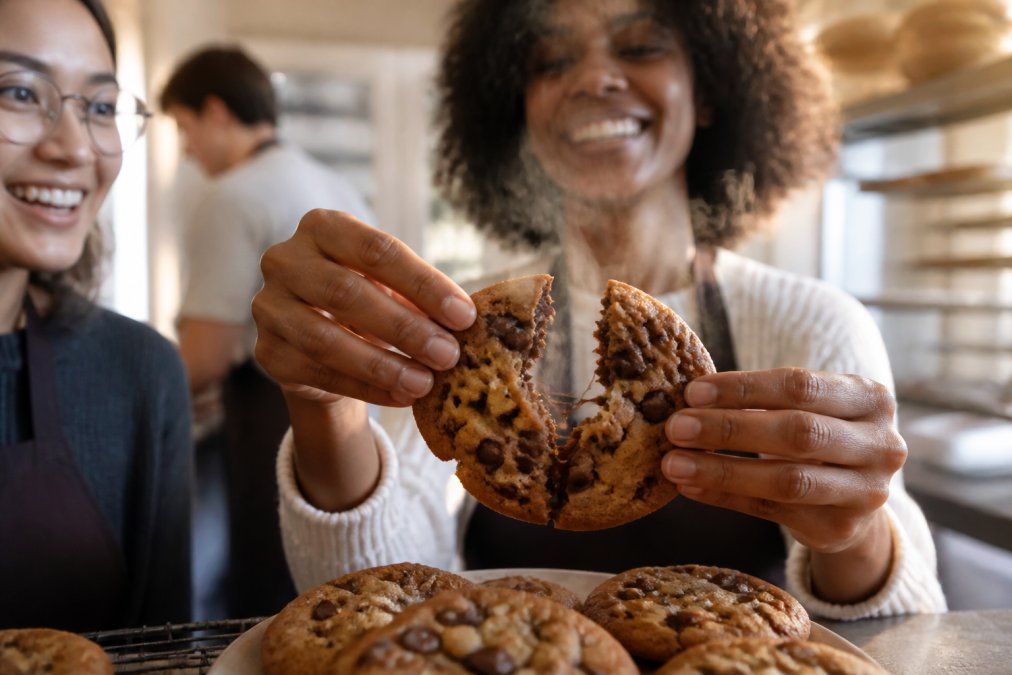
Texture separates the two paths hardest. A mall cookie that sat under a warmer for three hours has a soft, steamed crumb and frosting firming at the edges. A cookie baked 20 minutes ago has crisp edges, a chewy center, and chocolate that still moves.
Lura's Kitchen mixes are built for that second experience. Tura Lura's produces a tender center with delicately crisp edges, and the pecans add a satisfying crunch that holds up after cooling. Langston's delivers the same soft, chewy structure with lightly golden edges, minus the nuts.
Frosting quality is the most subjective category. Mall frosting is engineered for color retention and shelf display, so it's sweeter and firmer than a home buttercream. Love that dense, glossy finish? Nothing at home replicates it exactly. Prefer a lighter hand? Home baking gives you control.
Gourmet Cookie Gifts: Presentation, Shipping, and Special Occasions
Gourmet cookie gifts split into two logistics problems. One is a finished, decorated object that must survive a journey. The other is a dry mix that arrives intact so the recipient bakes on their own schedule. Knowing which problem you're solving separates a gift that lands well from one that arrives as a crumbled apology.
The finished-cookie-cake problem. A frosted, decorated cookie cake looks finished the moment you carry it out of the store, which is its appeal. But that frosting makes it fragile in transit: icings soften as temperatures rise, and a decorated surface can slide, smear, or crack against a box lid. Local pickup is a non-issue; a cross-country summer shipment is a real gamble, and most shippers won't guarantee a frosted item against heat damage.
The dry-mix advantage. A sealed dry mix is shelf-stable, lightweight, and indifferent to the bumps and temperature swings of parcel handling. It doesn't melt, smear, or need cold packs or expedited freight, making it the more reliable choice for long-distance gifting. The trade-off is philosophical: you're gifting an experience rather than a finished object, which some recipients read as thoughtful and others as homework.
Matching the gift to the occasion.
- Local birthday or office celebration: A decorated cookie cake wins on zero-effort presentation. You walk in, you walk out, it's done.
- Long-distance holiday gift: A dry mix wins on arrival condition and on the personal touch of a batch baked by the person who received it.
- New-parent or get-well gift: A mix that bakes in a single session is easier to actually use than a perishable cake that has to be eaten within a day or two.
- Teacher or hostess gift: A mix paired with a note reads as a keepsake rather than a consumable, and it stores on a shelf until the recipient is ready.
Timing and packaging notes. Shipping a mix? A padded mailer or small cushioned box is enough; the contents are dry and dense. Shipping anything frosted? Plan around weather, ship early in the week so the package doesn't sit in a warehouse over a weekend, and set expectations about what the decoration may look like on arrival.
Easy Home-Baked Cookie Recipes: DIY vs Store-Bought Costs
Easy home-baked cookie recipes start with a cost question, and the honest answer depends on what you're counting. The real comparison has three paths, not two: buy finished cookies, bake from a mix, or bake fully from scratch. Each wins in a different scenario.
Path 1: Buying finished cookies. For one person wanting one cookie, the counter is cheaper and faster. That math flips the moment you're feeding a group: buying four dozen individual cookies one at a time costs considerably more than baking them, and you're paying for labor, packaging, and retail overhead in every unit.
Path 2: Baking from a mix. A mix makes roughly 3 to 4 dozen medium cookies from a single package. Once you add eggs and butter, the per-cookie cost drops well below what a counter charges, and the labor is minimal because the dry ingredients are already measured and blended. This is the middle path: less work than scratch, lower cost than retail, and consistent results every batch.
Path 3: Baking fully from scratch. From-scratch baking has the lowest ingredient cost on paper, but it's the most misleading number here. You buy flour, sugar, brown sugar, leavening, salt, vanilla, chocolate, and nuts separately, and unless you bake constantly, you're buying full containers to use a fraction of each. The pantry math rarely works out as cheaply as it looks, and you absorb the measuring, sifting, and cleanup yourself.
The hidden cost nobody counts: time and cleanup. From-scratch baking means measuring flour, sugar, leavening, and salt, plus the bowls, scoops, and counter mess. A mix removes the dry-ingredient measuring entirely, the part most families find tedious. If your time has any value, the mix closes most of the gap with scratch and beats retail outright.
Bulk and corporate catering. A corporate order of individually wrapped cookies is convenient but priced per unit, with no resale or reuse. A bulk bake from mixes lets an office, school club, or church group produce trays at a fraction of the per-unit retail cost, with consistent results across dozens of cookies. For fundraisers, that margin is the whole point: buy at a set price, bake in batches, sell at a markup.
Quick decision guide.
- One or two cookies, right now: Buy finished. The counter wins.
- A party platter or holiday exchange: Bake from a mix. Best balance of cost, effort, and freshness.
- A bake sale or fundraiser: Bake from a mix in volume. The margin is the model.
- A serious hobby baker with a stocked pantry: Scratch can work, but only if you already own the ingredients.
Ingredient Quality, Allergen Awareness, and Bakery Standards
Easy Home-Baked Cookie Recipes: DIY vs Store-Bought Costs
Ingredient Quality, Allergen Awareness, and Bakery Standards
Ingredient sourcing is where mixes can quietly beat a storefront, because you can read the label before you buy. Lura's Kitchen mixes list recognizable components: all-purpose flour, pure cane sugar, premium vanilla, baking powder, sea salt, semisweet chocolate morsels, and chopped pecans, with no artificial flavors or preservatives.
Allergen awareness is the flip side. Mall cookies are often produced in shared facilities with tree nuts, and cross-contact is a genuine concern for anyone with an allergy. Tura Lura's contains pecans, so it's off the table for a nut allergy, but Langston's No-Nonsense Chocolate Chip is made without added nuts, which makes it the simpler pick for a mixed group.
Bakery standards cut both ways. A commercial bakery operates under food-safety oversight and consistent portioning, which is real value. A home kitchen gives you control over handling, but the consistency is on you.
Occasion-Based Suitability: Corporate Catering, Parties, and Fundraisers
Corporate catering and fundraisers reward volume, consistency, and low handling effort, and that's where the two options diverge. A mall order works for a single office delivery, but it's a per-order transaction with no margin for resale.
Fundraisers are the strongest case for mixes. A group buys mixes at a set price, bakes them in batches, and sells individual cookies or packs at a markup, which is a workable model for a church group, a school club, or a bake sale. Lura's Kitchen was partly built around that use case, and the family-size packaging supports it.
Parties sit in the middle. For a kids' birthday, a decorated cookie cake is the easier centerpiece. For a family reunion, Sunday dinner, or holiday cookie exchange, a few batches of fresh cookies on a platter do more than a store-bought tray.
Conclusion
The real challenge with great American cookies vs alternatives isn't picking a winner; it's matching the option to the moment. Mall cookies win when you need a decorated centerpiece today with zero effort. Home-baked mixes win when you want fresh cookies, control over ingredients, and enough to share without a per-cookie bill.
That's where Lura's Kitchen fits. Our mixes are built on multi-generational Southern and African American family recipes, and they're designed so anyone can bake a batch without measuring dry ingredients or creating a mess. Langston's No-Nonsense Chocolate Chip, Tura Lura's Chocolate Chip Pecan, and Madear's Old Fashion Teacake Mix cover the classic, the indulgent, and the nostalgic, and each one makes 3 to 4 dozen cookies from a single package. Every batch carries a legacy worth passing on, because at Lura's Kitchen, it's all in the mix.

Frequently Asked Questions
Why are Great American Cookies so expensive compared to alternatives?
Mall-based cookie chains carry overhead costs like rent, staffing, and display cases, which push prices higher per cookie. Alternatives such as Lura's Kitchen mixes start at $22.99 and yield 3 to 4 dozen cookies, bringing the per-cookie cost down significantly. For gatherings or gifting, a gourmet mix often delivers better value without sacrificing flavor or visual appeal.
How do gourmet cookie gifts compare to mall-bought cookie cakes?
Gourmet cookie gifts like Lura's Kitchen Legacy Mix Collection arrive as a bake-at-home experience, which many recipients find more personal than a pre-made cake. The Tura Lura's Chocolate Chip Pecan mix at $26.99 includes premium ingredients like Texas Pasa pecans and semisweet morsels, and the recipient bakes fresh cookies whenever they choose. That freshness and thoughtfulness often outweigh the convenience of a ready-made cake.
Are home-baked cookie alternatives more cost-effective than retail chains?
Yes, in most cases. A single mall cookie can cost $3 to $5, so two dozen cookies runs $72 to $120. Lura's Kitchen mixes range from $22.99 to $26.99 and make 3 to 4 dozen cookies, plus the cost of eggs and butter. The savings grow with larger orders, and you get freshly baked cookies with a chewy texture and crispy edges that hold up well for events.
What makes a premium cookie mix a better gift than a pre-made cake?
A premium mix invites the recipient to participate in the baking, which creates a memory rather than just a delivery. Lura's Kitchen mixes come from a multi-generational, minority-owned benefit corporation, so the gift also supports a mission. The recipient gets the aroma of freshly baked cookies, a shareable batch, and the flexibility to bake on their own schedule.
How can I choose the best cookie brand for special occasions?
Match the brand to the occasion. For corporate catering or large parties, choose a mix that yields 3 to 4 dozen cookies per package and travels well, like Lura's Kitchen Langston's No-Nonsense Chocolate Chip at $24.99. For heritage-themed events, Madear's Old Fashion Teacake Mix at $22.99 brings Southern baking traditions. Consider flavor variety, allergen awareness, and portion size before deciding.
If you're planning a gathering, a gift, or a fundraiser, the easiest next step is to pick the mix that fits the occasion and bake a batch this weekend. Get started with Lura's Kitchen and put warm, homemade cookies on the table with a recipe that's been waiting generations to be shared.