

Table of Contents
- Why Baking With Kids Fits a Busy Home Cook's Schedule
- Easy Baking Activities for Toddlers That Build Real Skills
- Mess-Free Baking Tips for Families Who Hate Cleanup
- Time-Saving Baking Hacks for Busy Parents
- Gourmet-Quality Shortcuts Without Scratch Baking
- Ingredient Sourcing for Premium Results
- Bonding Through Baking: Turning Prep Into Family Time
- Frequently Asked Questions
Last Updated: September 16, 2026
Why Baking With Kids Fits a Busy Home Cook's Schedule
Baking with kids works for busy home cooks because the whole activity can finish in under 30 minutes when the dry ingredients are already measured. This guide from Lura's Kitchen is for parents who want gourmet-quality desserts without scratch-baking.
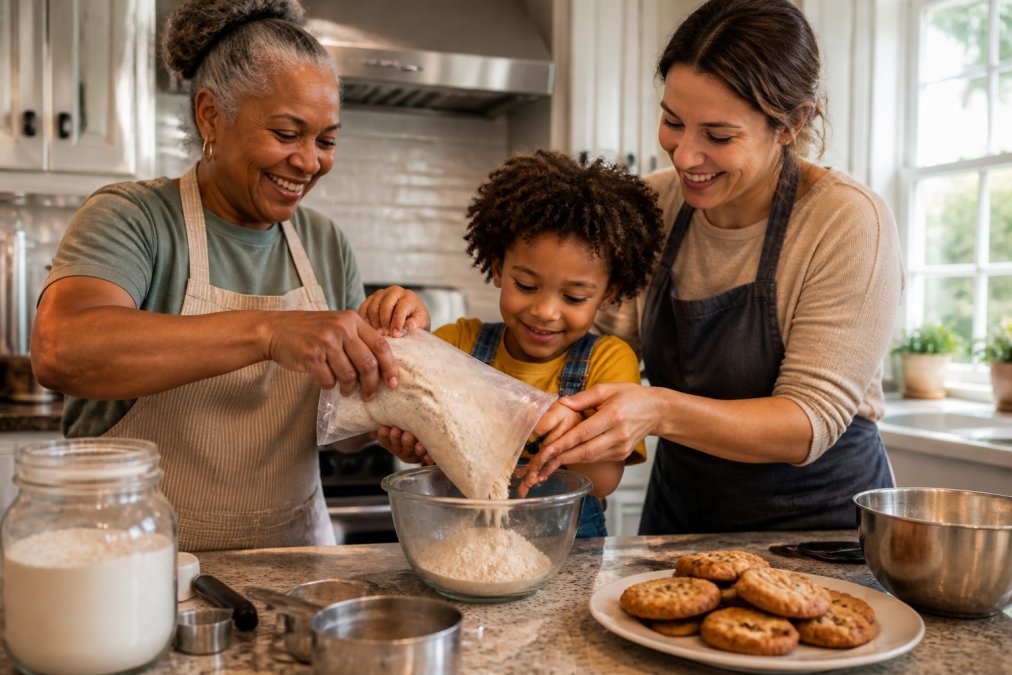
Easy Baking Activities for Toddlers That Build Real Skills
Easy baking activities for toddlers center on pouring, stirring, and scooping, three motions that build fine motor skills while producing something edible. The goal isn't a perfect cookie; it's a child who feels competent in a kitchen.
Age-Appropriate Kitchen Tasks From Two to Six
Match the task to the child's actual coordination, not their enthusiasm.
- Ages 2-3: Pour pre-measured ingredients into the bowl, press cookie dough with a flat palm, hand you the spoon.
- Ages 4-5: Stir soft dough with a sturdy spoon, drop dough onto the sheet with a scoop, wipe the counter.
- Ages 6+: Crack eggs into a separate bowl first, measure add-ins, set the timer, read the recipe aloud.
Pre-Measuring Ingredients So Toddlers Can Pour and Stir
Pre-measuring is the single highest-use habit for baking with a toddler. Set out every ingredient in its own small bowl before the child reaches the counter, and the session becomes a sequence of pours and stirs, no open flour bag, no measuring cup balanced on the edge.
Mess-Free Baking Tips for Families Who Hate Cleanup
Mess-free baking comes down to containment: one bowl, one sheet, one wipe-down. Parents who dread cleanup usually aren't doing anything wrong. They're just working without a system.
Kitchen Safety Basics for Young Helpers
Kitchen safety for kids is mostly about drawing clear lines before anything starts.
- Keep the oven and stovetop off-limits entirely for children under six.
- Turn pot and pan handles inward if you're working near a child.
- Set the hot sheet on a back burner or a cooling rack pushed well out of reach.
- Wash hands before and after, especially after handling raw egg.
- Never leave a child alone with a knife, even a butter knife.
Time-Saving Baking Hacks for Busy Parents
Time-saving baking hacks for busy parents come down to two moves: batch your prep on a day you have slack, and run a tight 30-minute workflow on the day you don't.
The Sunday Batch-Prep Session (20 Minutes)
Batch cooking for baking doesn't mean baking twelve dozen cookies at once. It means prepping the dry components, tools, and cleanup plan in one sitting. A 20-minute Sunday session sets up three or four weeknight bakes:
- Line two or three sheet pans with parchment and stack them so they're ready to grab.
- Set out the small bowls you'll use for pre-measured add-ins and stack them next to the mix.
- Toast a batch of pecans or walnuts and store them in a sealed jar.
- Fill a small jar with flaky salt and keep it next to the baking sheet.
- Wipe down the counter and set the mixing bowl, spoon, and scoop on it so the station is ready.
The 30-Minute Weeknight Workflow
Here's the actual clock for a busy Tuesday. Times assume the Sunday prep is done:
| Minute | Task | Who Does It |
|---|---|---|
| 0-3 | Preheat oven, pull mix and prepped bowls to the counter | Adult |
| 3-8 | Child pours pre-measured ingredients into the bowl | Child |
| 8-12 | Add eggs and butter, stir until dough comes together | Child with adult nearby |
| 12-18 | Scoop dough onto the lined sheet | Child |
| 18-20 | Adult slides sheet into oven, sets timer | Adult |
| 20-32 | Cleanup while cookies bake, child wipes counter, adult washes the bowl | Both |
| 32-35 | Cool on the rack, add finishing salt or dusting | Adult |
Semi-Homemade Shortcuts That Actually Save Time
A semi-homemade approach means starting from a quality mix and adding one signature touch: flaky salt, a dusting of confectioner's sugar, toasted nuts, or a cinnamon-sugar roll. The result reads as homemade because it largely is.
| Task | Scratch Baking | Semi-Homemade With a Premium Mix |
|---|---|---|
| Measure dry ingredients | 8-10 minutes | 0 minutes |
| Cream butter and sugar | 5 minutes | 0 minutes |
| Combine and scoop | 10 minutes | 6-8 minutes |
| Bake and cool | 12-15 minutes | 12-15 minutes |
| Cleanup | 15-20 minutes | 5-8 minutes |
What to Skip When You're Short on Time
- Chilling the dough. Nice for shape, not worth 30 minutes on a weeknight. Scoop and bake.
- Multiple add-ins. One signature touch reads as gourmet. Three reads as cluttered and adds prep time.
- Fancy decorating. Save icing and piping for weekends. A dusting of confectioner's sugar gets you 90% of the visual payoff in 10 seconds.
Gourmet-Quality Shortcuts Without Scratch Baking
Gourmet quality comes from ingredient sourcing and finishing technique, not from the number of steps you perform. These shortcuts move a cookie from 'good for a weeknight' to 'good enough for a dinner party.'
Tura Lura’s Chocolate Chip Pecan →
Four Finishing Moves That Read as Bakery-Made
Each of these takes under two minutes and works on any drop cookie or teacake:
- Flaky salt finish. Pinch a few flakes of sea salt over each scoop before baking. Salt suppresses bitterness in chocolate and makes the sweetness taste more deliberate. It is the single highest-return finishing move for a chocolate chip cookie.
- Brown butter swirl. Melt butter until the solids toast and smell nutty, then cool it back to room temperature before mixing. The dough picks up a toffee note that plain melted butter never delivers.
- Toasted nuts, not raw. Spread pecans or walnuts on a dry sheet pan and toast at 350°F for 6-8 minutes, until fragrant. Raw nuts taste flat and slightly bitter next to chocolate; toasted nuts taste roasted and sweet.
- Confectioner's sugar dusting. For teacakes and shortbread-style cookies, a fine dusting after cooling gives a finished, patisserie look with zero baking skill required.
Flavor Pairings That Taste Expensive
Gourmet flavor is mostly about pairing, not about adding more ingredients. A few combinations that consistently outperform plain chocolate chip:

- Semisweet chocolate with toasted pecan and a pinch of flaky salt
- Dark chocolate with a small amount of orange zest folded into the dough
- White chocolate with dried cranberry and a light dusting of confectioner's sugar
- Brown butter dough with a cinnamon-sugar roll before baking
Why a Premium Base Beats a Rushed Scratch Recipe
Ingredient Sourcing for Premium Results
Ingredient sourcing is where a busy cook closes most of the gap between homemade and bakery-quality. You don't need a specialty store, just the three or four items that actually change the outcome.
- Butter: Use unsalted butter so you control the salt. Let it come to room temperature before mixing, or the dough will break.
- Eggs: Room-temperature eggs emulsify more easily. If you forgot to take them out, rest them in a bowl of warm tap water for a few minutes.
- Chocolate: Chocolate with a higher cocoa percentage gives a deeper flavor and less cloying sweetness.
- Vanilla: Real vanilla extract, not imitation, is the difference between a cookie that tastes flat and one that tastes finished.
Bonding Through Baking: Turning Prep Into Family Time
Bonding through baking happens in the prep, not the finished plate. The ten minutes of pouring and stirring is where the conversation lives.
Frequently Asked Questions
What are some fun and easy no-bake recipes for kids?
No-bake treats let kids help without the oven. Try mixing crushed graham crackers with peanut butter and honey, then rolling into balls and chilling. Another option: layer yogurt, fruit, and granola in cups for a parfait. For a semi-homemade shortcut, use a premium cookie mix to make edible dough (without raw eggs) and press into a pan for no-bake bars. These activities build fine motor skills and keep little hands busy without heat.
How can I make baking with kids less messy?
Set up a workstation with a wipeable mat, pre-measure all ingredients into small bowls, and give each child their own mixing spoon. Use a large rimmed baking sheet under the mixing bowl to catch spills. Keep damp cloths nearby. Choose mixes that require only a few add-ins, like butter and eggs, to reduce the number of ingredients and steps. A mess-free baking tip for families is to assign one child as the 'pourer' and another as the 'stirrer' to minimize chaos.
What are the best ways to teach toddlers to bake?
Start with simple, hands-on tasks: pouring pre-measured ingredients, stirring (with help), and pressing cookie dough onto a sheet. Use a sturdy step stool so they can reach the counter safely. Narrate each step and let them smell the vanilla or nutmeg. Choose a mix that needs just a few additions so toddlers can participate from start to finish. Keep sessions short, 15 to 20 minutes, and celebrate the final cookie together.
How do busy parents maintain gourmet quality while baking with children?
Use a premium mix that already blends quality ingredients like pure cane sugar, real vanilla, and semisweet chocolate. This removes the measuring and balancing act of scratch baking. Add fresh butter and eggs for homemade flavor. For consistent results, scoop dough with a cookie scoop and bake on parchment. A time-saving baking hack for busy parents is to pre-scoop dough onto a sheet and freeze, then bake only what you need. That way, every batch tastes gourmet without the work.
What are the benefits of baking with kids for family bonding?
Baking creates shared focus and teamwork. Children feel proud when they contribute to a dessert the whole family enjoys. The process encourages conversation, patience, and sensory learning. It also builds kitchen confidence and culinary skills over time. Even a 20-minute session can become a cherished routine. The aroma of cookies baking brings everyone together, making the kitchen a gathering place. It's all in the mix of laughter, learning, and a sweet treat.
How do I choose age-appropriate baking tasks for children?
For ages 2 to 3: pouring pre-measured ingredients, stirring with help, and pressing cookie cutters. Ages 4 to 5: cracking eggs (with a separate bowl), scooping dough, and decorating. Ages 6 to 8: measuring, mixing, and using a cookie scoop. Ages 9 and up: reading the recipe, operating the oven with supervision, and timing. Always match the task to the child's fine motor skills and attention span, and keep safety first.