
Table of Contents
- Toddler Kitchen Safety Tips Before You Start
- Essential Baking Tools for Toddlers
- Age-Appropriate Tasks: What Toddlers Can Actually Do
- 5 Easy Baking Activities for Toddlers to Try This Week
- Allergy-Friendly Baking Activities for Toddlers
- How to Manage the Mess Without Losing Your Mind
- Educational Benefits of Baking with Toddlers
- Conclusion
Last Updated: August 16, 2026
Toddler Kitchen Safety Tips Before You Start
Baking with toddlers can be deeply rewarding, but preparation is essential. The kitchen contains genuine hazards, hot surfaces, sharp edges, and heavy equipment, that require deliberate safety measures. According to Safe Kids Worldwide's kitchen safety guidelines, burns are among the most common home injuries for children under five, with most occurring in the kitchen.
Setting Up a Toddler-Safe Workspace
A toddler-safe workspace is a designated counter-height area where your child can participate without reaching toward hazards. Clear the area of knives, graters, and appliances with exposed heating elements before they join you.
Essential setup steps:
- Place a silicone mat or damp dish towel under mixing bowls to prevent sliding
- Keep the oven and stovetop completely off-limits; preheat the oven yourself
- Use a step stool with a non-slip base for comfortable working height
- Move hot items to the back of the counter, out of reach
Supervision Rules That Actually Work
Effective supervision means staying within arm's reach whenever your toddler is near the oven, mixer, or any liquid that could spill. Assign yourself one active task, stirring, measuring, reading the recipe, so you're engaged, not just present. If you need to step away, bring your toddler with you or pause the activity entirely.
Essential Baking Tools for Toddlers
Standard kitchen equipment is designed for adult hands. The right child-sized tools make the difference between frustration and fun.
| Tool | Why It Works for Toddlers | What to Look For |
|---|---|---|
| Small mixing bowl | Fits small hands, less spillage | Lightweight, with a pour spout |
| Silicone spatula | Flexible, safe, easy to grip | Short handle, rounded edge |
| Measuring cups | Builds math skills through play | Plastic, color-coded by size |
| Cookie cutters | Satisfying, low-risk task | Smooth edges, simple shapes |
| Rolling pin | Great for sensory engagement | Child-sized, lightweight |
| Parchment paper | Reduces sticking and cleanup | Pre-cut sheets for baking sheet |
Avoid metal tools with sharp edges and anything electric for unsupervised use. A child-sized apron signals to your toddler that this is their time and catches mess effectively.
Age-Appropriate Tasks: What Toddlers Can Actually Do
Matching tasks to developmental stage keeps baking genuinely fun rather than frustrating.
Baking with 2 Year Olds: Where to Begin
At this age, the goal is sensory participation, not precision. Good starting tasks include pouring pre-measured ingredients, stirring thick batter with your hand guiding, pressing cookie cutters into rolled dough, and sprinkling toppings. Skip measuring, cracking eggs, and anything requiring fine motor control they haven't developed yet.
Tasks for 3- and 4-Year-Olds
Three- and four-year-olds can handle significantly more: measuring dry ingredients with supervision, whisking eggs or milk, kneading soft dough, using a rolling pin, and placing cut shapes onto baking sheets. This is the age where food preparation starts to feel like a real contribution.
5 Easy Baking Activities for Toddlers to Try This Week
Simple Cookies with Cookie Cutters
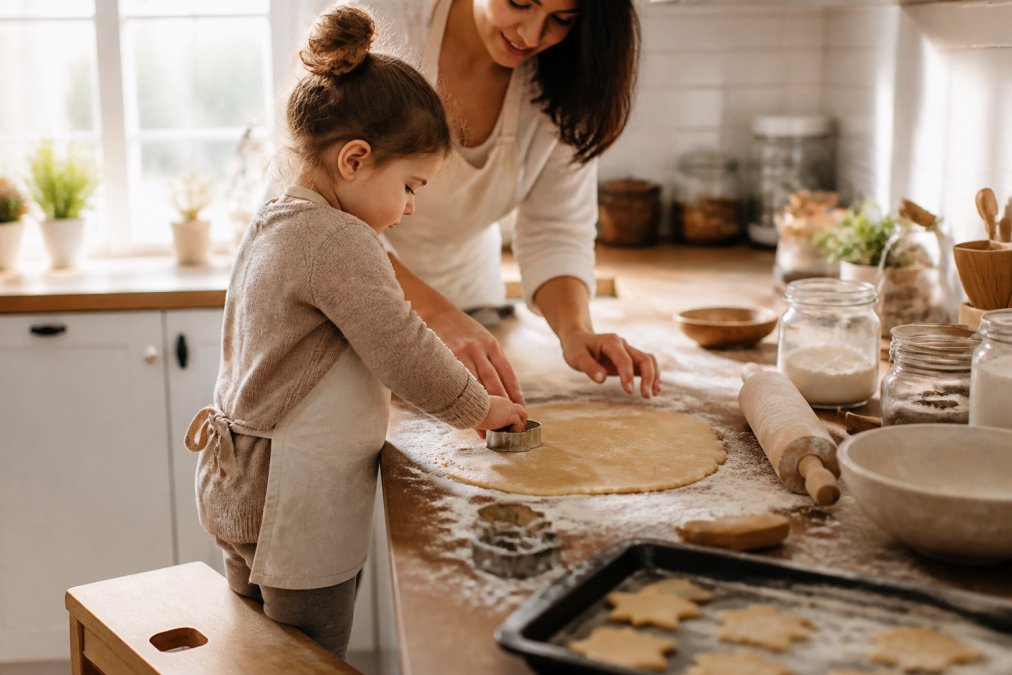
Cookie cutting is the best entry-point baking activity for toddlers. It requires no heat, no precision, and delivers an immediately satisfying result.
How to do it:
- Prepare or purchase simple dough (sugar cookie or shortbread works best)
- Roll dough to about 1/4 inch thickness on a lightly floured surface
- Let your toddler choose cookie cutters and press straight down
- Transfer shapes to a parchment-lined baking sheet together
- Bake according to recipe while your toddler watches safely from a distance
- Cool completely before decorating
Lura's Kitchen cookie mixes are an easy starting point, with dough that comes together quickly and a forgiving texture.
Mini Muffins and Quick Breads
Mini muffins are ideal because portions are small, baking time is short, and the process involves lots of pouring and stirring. Set out pre-measured dry and wet ingredients in separate bowls, let your toddler pour dry ingredients into the mixing bowl, add wet ingredients yourself, then hand over the spatula for stirring. Spoon batter into a non-stick mini muffin tin together, then you preheat and bake. Simple add-ins like blueberries or chocolate chips let toddlers personalize their batch.
Sensory-Focused Baking: Kneading and Rolling Dough
For toddlers, kneading dough is a rich sensory experience that engages multiple senses simultaneously. Make a simple yeast-free dough, give your toddler a golf-ball-sized portion on a silicone mat, and let them explore freely for 5-10 minutes before introducing the rolling pin.
Allergy-Friendly Baking Activities for Toddlers
Allergy-friendly baking doesn't mean sacrificing texture or flavor. Many families manage multiple dietary needs simultaneously with simple ingredient swaps.
Practical allergy-friendly substitutions:
- Egg-free: Use a flax egg (1 tablespoon ground flaxseed + 3 tablespoons water, rested for 5 minutes)
- Dairy-free: Substitute oat milk or almond milk for cow's milk; use coconut oil for butter
- Gluten-free: Use a 1:1 gluten-free flour blend with xanthan gum already included
- Nut-free: Sunflower seed butter reliably replaces peanut butter
According to FARE (Food Allergy Research & Education) guidance for families, involving children with food allergies in supervised food preparation builds their confidence and food awareness from an early age. The toddler-appropriate tasks remain the same regardless of recipe.
How to Manage the Mess Without Losing Your Mind
Baking with toddlers is messy. The goal isn't to eliminate mess, it's to contain it and reframe it as part of the activity.
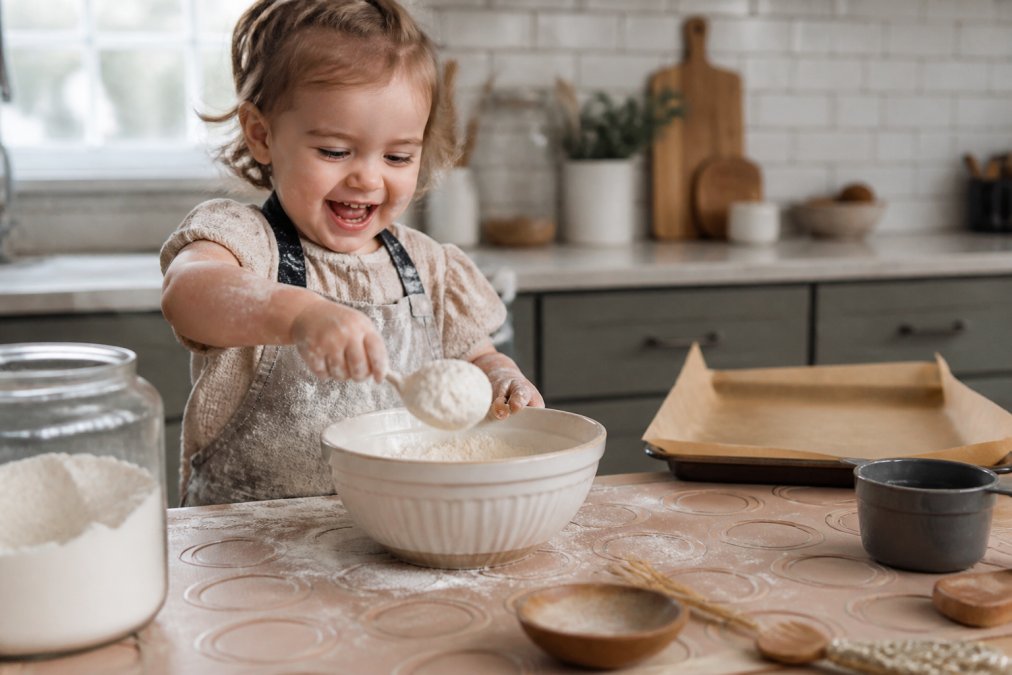
Effective mess management strategies:
- Lay a large silicone mat or old tablecloth across your entire work area before starting
- Keep a damp cloth within reach for quick wipe-downs mid-session
- Use a baking sheet with raised edges to catch rolling ingredients
- Measure everything into small bowls before your toddler joins
- Accept that flour will end up on the floor and dress accordingly
Treat the mat as a contained zone where everything is fair game.
Post-Baking Cleanup Games for Toddlers
Post-baking cleanup is an opportunity to build responsibility and make the session feel complete. Toddlers respond to purposeful, time-bounded tasks: a wipe race with a damp cloth, sorting measuring cups by size, sweeping flour with a small dustpan and brush, or a two-minute countdown to see how much can be put away. Cleanup becomes part of the fun instead of the end of it.
Educational Benefits of Baking with Toddlers
Baking with toddlers is an educational activity that covers multiple developmental domains simultaneously. According to the CDC's developmental milestones guidance for early childhood, activities combining fine motor skills, language, and problem-solving are among the most effective for early childhood development.
What toddlers learn during baking:
- Math and measurement: Filling measuring cups and counting scoops build concrete early numeracy
- Following instructions: Sequential steps develop the ability to follow directions in other contexts
- Cause and effect: Wet plus dry plus heat equals transformation, genuinely fascinating to toddlers
- Language development: Describing textures and temperatures builds vocabulary in context-rich ways
- Patience and delayed gratification: Waiting for baking time teaches one of the earliest lessons in patience
Side-by-side cooking is one of the oldest forms of connection between generations. Families who bake together regularly report that the kitchen becomes a place of comfort and communication.
Baking activities for toddlers don't have to be elaborate to be meaningful. Lura's Kitchen offers cookie mixes and pre-baked treats specifically designed for family baking: mess-free preparation, simple ingredients, and results kids are proud to share. Shop Lura's Kitchen and turn your next kitchen session into a memory worth repeating.
Frequently Asked Questions
What are some easy baking activities for toddlers at home?
Cookie decorating, muffin mixing, and dough kneading are all great starting points for easy baking activities for toddlers. Give your child a mixing bowl, measuring cups, and a silicone spatula, then let them pour pre-measured pantry staples and stir. Cookie cutter shapes are especially popular because toddlers can press them into dough independently. Using a ready-made cookie mix simplifies prep even further, so the focus stays on the fun rather than complicated steps.
What can I bake with a 2 year old?
Baking with 2 year olds works best with tasks that need no sharp tools and minimal precision. Let them pour ingredients into a bowl, stir with a large spoon, or press cookie cutters into pre-rolled dough. Simple drop cookies and muffins made from a few pantry staples are ideal. Keep the baking time short and the steps few. A mix-based recipe cuts down on measuring and keeps the activity manageable for both of you.
How do I keep a toddler engaged while baking?
Give toddlers one clear job at a time: pouring, whisking, or pressing a cookie cutter. Rotate tasks every few minutes to hold their attention. Sensory elements help too, let them touch the dough, smell the spices, and watch the batter change texture. Narrate each step out loud so they feel like a real kitchen helper. Keeping the entire activity under 20 minutes prevents frustration and ends on a high note before interest fades.
Are baking mixes actually safe and simple enough for kids to help with?
Yes, a quality baking mix removes most of the tricky steps that make scratch baking hard for young helpers. Pre-measured dry ingredients mean toddlers can pour and stir without the risk of wrong ratios. The result is more consistent, which matters when a child is helping and measurements are approximate. Look for mixes with simple ingredient lists and short baking times so the whole experience stays fun and age-appropriate from start to finish.
This article was written using GrandRanker