

Table of Contents
- Why Do My Cookies Come Out Dry? The 6 Real Causes
- Cause 1: Too Much Flour From Packed Cups
- Cause 2: Overbaking and Carry-Over Cooking
- How to Measure Flour for Cookies Without Packing It
- Why Is My Cookie Dough Crumbly? Fat, Sugar, and Hydration
- How to Fix Dry Cookie Dough Before It Hits the Oven
- Why Do Cookies Get Hard After Cooling? Moisture and Storage
- Oven Calibration and Altitude: The Dry-Cookie Variables Nobody Checks
- Frequently Asked Questions
Last Updated: October 20, 2026
Why Do My Cookies Come Out Dry? The 6 Real Causes
Dry cookies almost always trace back to one of six culprits: too much flour, overbaking, weak fat-to-sugar balance, cold ingredients, poor storage, or an oven running hot.
Here's the good news. Most dry batches come from measurement habits, not bad recipes. Once you know what to check, you can correct it on the next batch.
Below, we'll show you exactly what causes cookies come out dry and how to fix each one before the dough ever touches a baking sheet.
Cause 1: Too Much Flour From Packed Cups
Packed flour is the number one reason cookies come out dry.
That extra flour throws off your liquid-to-solid ratio. The dough turns stiff, the cookies bake up chalky, and the texture goes from chewy to cakey.
The fix is simple: fluff the flour with a spoon, sprinkle it into your cup, then level it with a knife. Better yet, weigh it.
Cause 2: Overbaking and Carry-Over Cooking
Overbaking dries cookies out faster than any other mistake. The edges look done, you leave them in another two minutes, and the whole batch turns crisp and hard.
Carry-over cooking makes it worse. Cookies keep baking on the hot sheet after you pull them from the oven. That residual heat can push a perfectly soft cookie into dry territory.
Pull your cookies when the centers still look slightly underdone and the edges are just set.
How to Measure Flour for Cookies Without Packing It
Measuring flour correctly is the fastest way to stop dry cookies. Use a kitchen scale if you have one, or spoon-and-level if you don't.
Here's the step-by-step method:
- Fluff the flour in its container with a spoon.
- Spoon it gently into your measuring cup.
- Fill until it mounds above the rim.
- Level it flat with a knife edge.
- Never pack, tap, or shake the cup.
Volume measurement is where most bakers go wrong. A packed cup can weigh far more than a spooned cup, and that difference alone can dry out a batch.
Why Is My Cookie Dough Crumbly? Fat, Sugar, and Hydration
Crumbly dough signals a fat-to-dry ratio problem.
Fat coats the flour and limits gluten formation, which keeps cookies tender. Sugar pulls in moisture and helps the dough spread.
Room temperature ingredients matter here too. Cold butter doesn't cream properly, so the fat never fully blends with the sugar.
If your dough still crumbles, add a small amount of softened butter or an extra egg yolk and mix gently until it holds.
Tura Lura’s Chocolate Chip Pecan →
How to Fix Dry Cookie Dough Before It Hits the Oven
You can rescue dry cookie dough before baking, but the fix depends on why it's dry. Adding fat to dough that's simply cold and stiff will make it greasy; adding an egg yolk to dough that's already over-floured will make it cakey. Diagnose first, then correct.
Step 1: Diagnose the dough
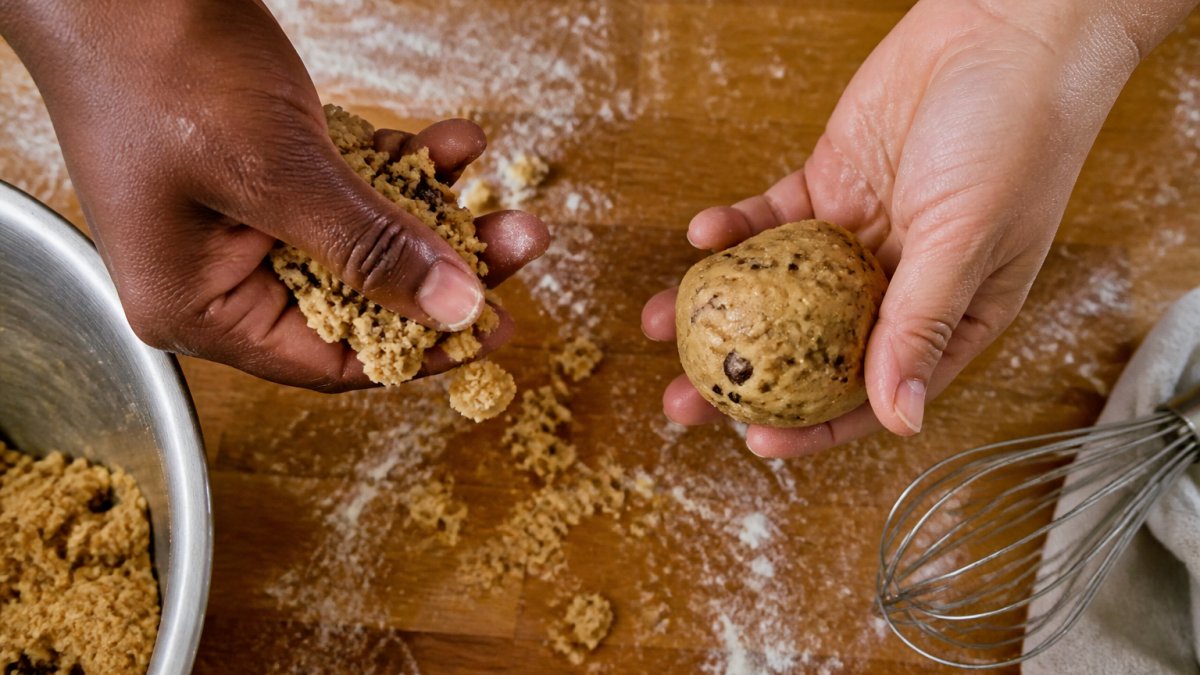
Squeeze a golf-ball-sized piece in your palm and open your hand.
- It holds its shape and leaves a clean imprint, the dough is fine. Stop here and chill it.
- It crumbles apart immediately, the dough is under-hydrated or under-fatted. Go to Step 2.
- It smears and sticks to your fingers, the dough is too warm, not too dry. Chill it 20 minutes before judging.
- It looks smooth but feels stiff and waxy, the fat wasn't creamed enough. Let it rest 10 minutes, then fold gently.
Step 2: Match the fix to the cause
| What you see | Likely cause | Fix (in order) |
|---|---|---|
| Crumbly, won't hold | Too much flour | Rest 10 minutes, then add 1 tbsp softened butter per batch |
| Crumbly and pale | Not enough fat | Beat in 1 egg yolk, mix just until combined |
| Stiff and matte | Flour hasn't hydrated | Cover and rest 15-20 minutes |
| Cracks at the edges when rolled | Low fat-to-sugar ratio | Add 1 tbsp softened butter plus 1 tsp sugar |
Work in small increments and re-squeeze after each addition. A single tablespoon of butter is enough to change the texture of a standard batch, you are correcting, not rebuilding.
Step 3: Rest before you bake
Resting is the most underused fix. Flour needs time to absorb the fat and any liquid already in the dough, and gluten needs time to relax. A 20-minute rest at room temperature often turns a crumbly dough into a cohesive one with no additions at all. If you're not baking right away, wrap and chill for up to 48 hours, chilled dough spreads less and bakes chewier.
Stop mixing the moment the dough comes together. Overmixing develops gluten and toughens the final cookie.
Ingredient substitutions that change moisture
If you swapped an ingredient, that's often the real culprit:
- Margarine or tub spread for butter, higher water content, so dough can turn out wetter and bake drier at the edges. Use stick butter for the most predictable result.
- Bread flour for all-purpose, higher protein absorbs more liquid and produces a drier, chewier crumb. Add 1 tbsp extra fat per cup of bread flour swapped.
- Brown sugar for white, brown sugar holds more moisture, so an all-white-sugar batch dries out faster. Keep at least half brown sugar for soft cookies.
- Egg whites only, the white adds structure but no fat. Use whole eggs or add an extra yolk.
Why Do Cookies Get Hard After Cooling? Moisture and Storage
Cookies get hard after cooling because they lose moisture to the air. Once they sit out uncovered, the sugars crystallize and the texture turns crunchy.
Proper storage solves this. Store cooled cookies in an airtight container with a slice of bread or a piece of apple.
A cooling rack matters too. Leaving cookies on the hot sheet traps steam and can make them soggy, then hard.
For longer storage, freeze baked cookies in a sealed bag. They thaw soft and taste fresh for weeks.
Oven Calibration and Altitude: The Dry-Cookie Variables Nobody Checks
Most bakers never check their oven temperature, and that's a hidden cause of dry cookies. An oven running hot bakes the outside before the center sets, so cookies dry out fast. This is the variable almost no cookie guide covers, and it explains a lot of "mystery" dry batches.
Test your oven in 30 minutes
- Place an independent oven thermometer on the center rack.
- Heat the oven to 350°F and let it cycle for 20 minutes, ovens overshoot on the first climb.
- Read the thermometer at the moment the heating element clicks off, then again 5 minutes later.
- Note the swing. A 25°F difference is common; a 50°F difference means your dial is lying to you.
If your oven runs hot, drop the set temperature by the difference and shorten the bake by 1-2 minutes. If it runs cold, raise the temperature and add time in 1-minute increments, checking at the window rather than opening the door.
(/products/langstons-no-nonsense-chocolate-chip) take the guesswork out of the dry ingredients.At Lura's Kitchen, we believe great baking should feel simple and shared. It's all in the mix.
Frequently Asked Questions
Why are my cookies dry and crumbly even when they look done?
Dry, crumbly cookies usually mean too much flour or too little fat. When flour is scooped straight from the bag, it compacts and you can end up with 20 to 25 percent more than the recipe calls for. That extra flour absorbs the available moisture and leaves a chalky, crumbly crumb. Weigh your flour on a kitchen scale or spoon it into the cup and level it off. Also check your fat-to-dry ratio: if you cut back on butter or used a spread with less fat, the dough has less moisture to work with and bakes dry.
Can overbaking make cookies dry?
Yes, and it is the most common cause after flour measuring. Cookies keep baking on the hot sheet after you pull them out, a process called carry-over cooking. If you wait until the centers look fully set, they will be overbaked by the time they cool. Pull them when the edges are lightly golden and the centers still look slightly underdone, then let them rest on the baking sheet for 5 minutes before moving them to a cooling rack. Check your oven temperature with an independent thermometer too, since many home ovens run 25 to 50 degrees hot.
How can I fix cookie dough that is too dry?
Add moisture in small amounts. Sprinkle 1 tablespoon of beaten egg or softened butter over the dough and work it in by hand, then check the consistency before adding more. A dough that holds together when squeezed but is not sticky is about right. If the dough has already been chilled and crumbles, let it sit at room temperature for 15 to 20 minutes, then press it together. For crumbly dough caused by packed flour, a splash of vanilla extract or a teaspoon of butter can bring it back without changing the flavor much.
Why do cookies get hard after cooling?
Hard cookies usually lost moisture during baking or absorbed it from the air afterward. Overbaking drives out water, and storing cookies uncovered lets them dry out further. Once fully cool, store them in an airtight container with a slice of bread or a piece of apple; the cookie pulls moisture from the bread and softens within a few hours. Sugar-to-fat ratio matters too: recipes with more sugar than fat tend to crisp as they cool, while a higher butter ratio keeps the center chewy.