
Table of Contents
- Travel-Safe vs Messy: A Quick Comparison Table
- Easy Dessert Recipes for Beginners That Hold Up in Transit
- Best Potluck Desserts to Transport Without a Mess
- Transport Logistics: Structural Integrity and Temperature Control
- Freezer-Friendly and Make-Ahead Desserts for Meal Trains
- Allergy-Friendly Travel Desserts and Dietary Swaps
- When Messy Treats Are Worth the Risk
- Frequently Asked Questions
Last Updated: September 20, 2026
Travel-Safe vs Messy: A Quick Comparison Table
Choosing simple dessert recipes that travel well vs messy treats comes down to one question: will this survive the car ride, the walk from the parking lot, and two hours on a folding table? Travel-safe desserts hold their shape, resist heat, and need no utensils. Messy treats taste incredible but demand refrigeration, careful packing, or a plate and fork.
This guide breaks down which desserts make the trip and which ones fall apart before the party starts. Below, you'll find a side-by-side comparison, packing logistics, make-ahead options, and allergy-friendly swaps. The comparison table here is the fastest way to see the difference.
| Factor | Travel-Safe Desserts | Messy Treats |
|---|---|---|
| Structure | Holds shape in transit | Slumps or cracks |
| Utensils needed | None | Plate and fork |
| Temperature risk | Low | High |
| Best examples | Cookies, brownies, teacakes | Frosted cakes, puddings |
| Cleanup | Minimal | Significant |
Easy Dessert Recipes for Beginners That Hold Up in Transit
The easiest beginner desserts for travel are cookies, bars, and no-bake bites, because they set firm and pack flat. A common mistake is choosing a recipe based on flavor alone and ignoring how it behaves after an hour in a warm car.


Start with recipes built on pantry staples: flour, sugar, butter, eggs, oats, and chocolate. These keep well and rarely need refrigeration once baked.
No-Bake Options and Pantry Staples
No-bake bars and cereal clusters skip the oven entirely and firm up in the refrigerator before you pack them. Prep time runs 15 to 20 minutes, plus chilling.
- No-bake oat bars: oats, peanut butter, honey, chocolate chips
- Cereal clusters: melted chocolate, crispy cereal, dried fruit
- Shortbread fingers: butter, flour, sugar, pressed flat
- Rice treats: marshmallow, butter, puffed rice, cut into squares
Why Cookies and Bars Beat Cakes on the Road
Cookies and bars win on the road because they have no frosting to slide, no custard to spoil, and no crumb structure to collapse. A bundt cake can travel, but only in a rigid carrier and only in cool weather. Bars stack in a single container and come out looking the same as they went in.
Best Potluck Desserts to Transport Without a Mess
The best potluck desserts to transport are individually portioned, utensil-free items that guests can grab with one hand. Cookies, brownies, teacakes, and bite-sized treats top the list.
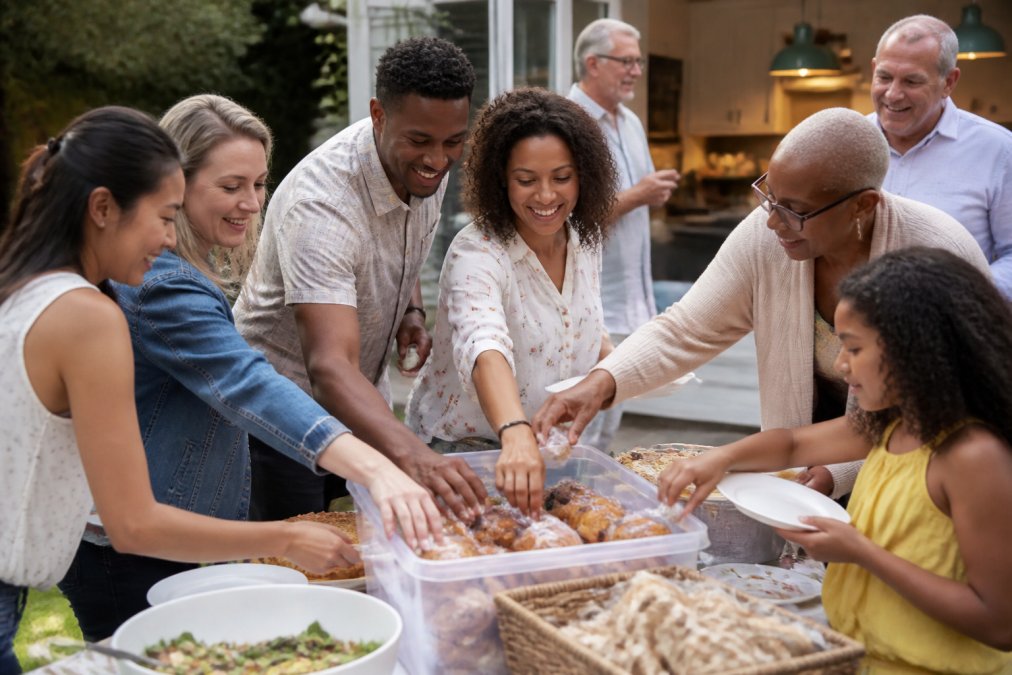
Crowd-size gatherings punish anything that needs last-minute assembly.
Handheld Treats for Crowd-Size Gatherings
Handheld treats solve the potluck problem because they need no serving spoon and no cleanup crew. Individually wrapped cookies and teacakes are the simplest option of all: guests take one, and nothing gets messy.
- Individually wrapped cookies for easy sharing and no cross-contact
- Brownie squares cut small and stacked in a single layer
- Teacakes with a soft, buttery crumb that survives a bumpy drive
- Shortbread that firms up rather than softening in the heat
Transport Logistics: Structural Integrity and Temperature Control
Structural integrity and temperature control decide whether your dessert arrives intact, and almost no recipe listicle covers either in real detail. This section does. Think of transport as three separate problems, crush, slide, and heat, and solve each one before the container lid goes on.
Crush: Stop the Stack From Collapsing
Weight is the enemy. A single deep container lets heavy bars press down on soft teacakes and fuse them into one slab. The fix is layering with rigid separation:
- Line the bottom with parchment, then add a second sheet of parchment between every layer.
- Cap each layer with a stiff cardboard round cut to the container's interior width, a cake board or a trimmed cereal-box panel works.
- Keep total stack height under about four inches so the lid never presses on the top layer.
- Place the densest items (brownies, shortbread) on the bottom and the lightest (teacakes, cereal clusters) on top.
Slide: Keep Frosting and Glazes Where They Belong
Anything with a frosting, glaze, or custard layer is a slide risk the moment the car turns. Two reliable approaches:
Madear’s Old Fashion Teacakes (baked) →
- Chill-set first. Refrigerate the finished dessert until the topping is fully firm, usually at least two hours, before it goes anywhere.
- Frost on site. Transport the bare layers in the pan, then assemble and frost at the destination. This is the only method that reliably survives a long drive in warm weather.
Heat: Match the Carrier to the Dessert
Temperature risk scales with the ingredients, not the recipe name. Use this as a working guide:
| Dessert type | Carrier | Notes |
|---|---|---|
| Plain cookies, shortbread, bars | Rigid lidded container, room temp | Most forgiving; keep out of direct sun |
| Teacakes, unfrosted loaf cakes | Rigid container, shaded seat | Avoid the trunk on warm days |
The Five-Minute Pre-Drive Check
Before you pull out of the driveway, run this sequence: lid seats without touching the top layer, container cannot slide more than an inch on the seat, gel pack is wrapped, nothing is stacked on top of the carrier, and you have a spare empty container for leftovers. Five checks, five minutes, and the difference between arriving with a dessert and arriving with a story about one.
Freezer-Friendly and Make-Ahead Desserts for Meal Trains
Freezer-friendly and make-ahead desserts let you batch cook weeks ahead, which is exactly what a meal train needs. Bake, cool, wrap tightly, and freeze.
- Bake a double batch and freeze half
- Wrap individual portions for easy thawing
- Label with the date so nothing gets lost
- Keep a stash ready for last-minute meal trains
Allergy-Friendly Travel Desserts and Dietary Swaps
Allergy-friendly travel desserts are possible with a few simple swaps, and they still hold up in transit. The key is to check labels and keep portions separate.
| Dietary Need | Simple Swap | Travel Note |
|---|---|---|
| Nut-free | Skip pecans and tree nuts | Check labels |
When Messy Treats Are Worth the Risk
Messy treats are worth the risk when the dessert is the centerpiece and you control the setting. The trick is to stop guessing and run the decision through three variables: distance, time out of refrigeration, and whether guests have a table and a fork. No ranking result turns this into an actual framework, so here is one.
The Distance-and-Time Matrix
Match your dessert to the trip, not to your craving:
| Trip profile | Time out of refrigeration | Safe choice | Risky choice |
|---|---|---|---|
| Under 15 minutes, indoor event | Under 1 hour | Almost anything | None |
| 15-45 minutes, warm day | 1-2 hours | Cookies, teacakes | |
| 45 minutes-2 hours | 2-3 hours | Individually wrapped cookies in a cooler bag | |
| Over 2 hours or outdoor summer event | 3+ hours | Firm cookies |
Event Type Changes the Answer
- Seated dinner, indoor: Messy treats are welcome. Bring the layer cake, the trifle, the plated dessert, there is a table, a fork, and a fridge.
- Potluck or buffet: Travel-safe wins. Guests are standing, holding a plate in one hand and a drink in the other. Utensil-free items disappear; anything needing a spoon gets abandoned.
- Meal train drop-off: Travel-safe wins again. The recipient may not eat for hours, and you will not be there to refrigerate it. Cookies and bars hold at room temperature far longer than a custard.
- Outdoor summer gathering: Travel-safe only. Heat, sun, and insects punish frosting and custard faster than any other setting.
The Three-Question Test
Before you commit to a messy dessert, answer these honestly:
- How far is the drive, and will the car be hot?
- Will there be refrigeration at the destination, and will you actually use it?
- Will guests have a table and a fork, or are they eating standing up?
Frequently Asked Questions
What is a good dessert that travels well?
Cookies, brownies, dessert bars, and shortbread are the best travelers because they hold their shape without refrigeration. Individually wrapped teacakes also work well since each portion stays intact. For potlucks and meal trains, stick with handheld, utensil-free options that can sit at room temperature for a few hours without losing structural integrity.
What are some simple dessert ideas for beginners?
Baking mixes take it a step further by removing measurement guesswork entirely. If you want something that looks impressive but stays simple, press cookie dough into a lined pan for bars instead of scooping individual cookies.
How do you transport delicate desserts without ruining them?
Use a flat-bottomed storage container and line it with parchment paper to prevent sliding. Place desserts in a single layer when possible, and fill gaps with crumpled parchment so items do not shift during transportation. For temperature control, use a cooler with a gel pack for anything that needs to stay cool, but keep cookies and bars at room temperature. Avoid stacking heavy items on top.
Why are handheld desserts better for large events?
Handheld desserts eliminate the need for plates, forks, and napkins, which cuts cleanup time and reduces mess. At a potluck or church gathering with a crowd-size group, utensil-free options let people grab and go without waiting in line. Individually wrapped items like teacakes also keep portions sanitary and make it easy to send leftovers home with guests.
What makes a dessert travel-friendly?
A travel-friendly dessert has four traits: it holds its shape without refrigeration, it does not require utensils, it packs in a single layer without sticking, and it tastes good at room temperature. Cookies meet these criteria, which is why they appear at nearly every potluck and meal train.