
Table of Contents
- Hula Cookies vs Homemade Mixes: The Real Difference
- Quick Comparison: Hula Cookies vs Homemade Mixes
- Taste and Texture: Convenience Baking vs Scratch Quality
- Cost Breakdown: Pantry Staples vs Store-Bought Mixes
- How to Improve Boxed Cookie Mix for Homemade Quality
- What Makes the Best Gourmet Cookie Mixes for Families
- Easy Baking Recipes for Families: Getting Kids Involved
- The Verdict: Which One Belongs in Your Kitchen?
- Frequently Asked Questions
Last Updated: September 9, 2026
The debate between hula cookies vs homemade mixes usually comes down to one question: do you want speed or do you want control? For home bakers, this choice shapes everything from the flavor profile to the time spent in the kitchen. The real answer is that a quality mix can deliver both convenience and that scratch-made taste families crave.
Hula Cookies vs Homemade Mixes: The Real Difference
The core difference between hula cookies vs homemade mixes lies in what you control versus what's already done for you. Scratch baking means measuring flour, sugar, leavening agents like baking soda and baking powder, plus your own vanilla and salt. A mix has those dry ingredients pre-portioned, which removes most of the guesswork and the risk of a flat or tough batch.
What most guides miss is that the gap has narrowed considerably. Premium mixes now use real ingredients without preservatives or artificial flavors, closing much of the distance between convenience baking and scratch quality. The trade-off is no longer "good or fast." It's about ingredient sourcing, cost-per-serving, and how much hands-on time you actually enjoy spending.
Quick Comparison: Hula Cookies vs Homemade Mixes
| Factor | Scratch Baking | Premium Mix (Lura's Kitchen) |
|---|---|---|
| Prep time | 20-30 minutes | 5-10 minutes |
| Ingredients to measure | 8-12 items | Add butter, eggs, milk |
| Flavor consistency | Varies by batch | Reliable every time |
| Cost-per-serving | Lower with bulk ingredients | Mid-range, no waste |
| Best for | Enthusiasts with time | Busy families, kids |
Scratch baking wins on total ingredient control, but a premium mix takes the lead on texture consistency and prep time. For a family weeknight or a bake sale where you need 3 to 4 dozen cookies without stress, the mix is the practical choice.
Taste and Texture: Convenience Baking vs Scratch Quality
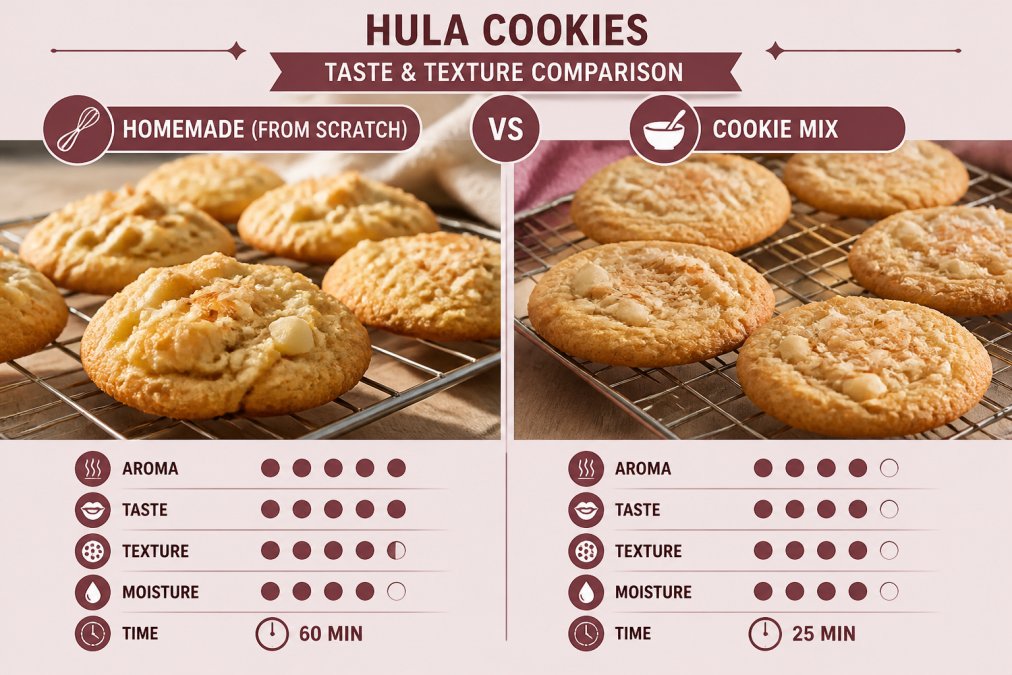
Texture is where many boxed mixes used to fall short, often turning out cake-like or dry. The difference isn't just about ingredients; it's about the chemistry of leavening and moisture. In scratch baking, you control the precise ratio of baking soda to baking powder, which determines spread and rise. Baking soda neutralizes acids (like brown sugar or buttermilk) to produce carbon dioxide, while baking powder is a complete leavening agent that reacts in two stages: once when wet, and again when heated. This dual action is what gives a cookie its initial lift and then its final structure.
A common pattern in cheaper mixes is the reliance on sodium acid pyrophosphate (SAPP) or other commercial leavening acids that react at lower temperatures. This can cause cookies to spread too quickly before the structure sets, resulting in a flatter, denser product. Scratch recipes, by contrast, allow you to use slow-acting acids like cream of tartar, which release gas more gradually, leading to a thicker, more chewy center.
Moisture content is another critical factor. Scratch recipes often call for creaming butter and sugar, a process that mechanically incorporates air and creates a stable emulsion. This trapped air expands in the oven, contributing to a lighter crumb. Many commercial mixes use shelf-stable fats or emulsifiers like mono- and diglycerides to mimic this texture without the need for cold butter or a stand mixer. While effective, these additives can leave a slightly waxy mouthfeel or a more uniform, less complex crumb structure.
A unique angle most guides miss is the role of starch gelatinization. In a scratch recipe, the flour's starch granules absorb water and swell at a specific temperature, setting the cookie's final shape. In a mix, the flour is often pre-gelatinized or treated to ensure a longer shelf life, which alters its absorption rate. This is why mix instructions often tell you to add an egg and butter at room temperature; the chemistry is calibrated for that specific state. When you add real butter and eggs at home to a premium mix like Lura's Kitchen, you reintroduce the natural fats and moisture that allow the starch to gelatinize properly, yielding that sought-after crisp edge and soft center.
For a deeper dive, consider the Maillard reaction, the chemical process responsible for browning and flavor development. Scratch baking lets you control the pH of the dough, which directly impacts this reaction. A slightly alkaline dough (often achieved with a touch of baking soda) promotes browning, while an acidic dough (from buttermilk or brown sugar) slows it down. Premium mixes are formulated to hit a middle ground, but they can't adapt to your specific oven or altitude. This is why a blind taste test often reveals that scratch cookies have a more nuanced, toasty flavor, while mix cookies taste sweeter and more one-dimensional, relying on sugar for flavor rather than the complex byproducts of browning.
Cost Breakdown: Pantry Staples vs Store-Bought Mixes
The true cost of baking isn't just the price tag on the ingredients; it's the cost per usable serving, accounting for waste, time, and the opportunity cost of a failed batch. A common pattern is to compare the $3.99 price of a mix against the $1.50 worth of flour and sugar used in a scratch recipe. This comparison is misleading because it ignores the capital outlay required to stock a pantry.
Consider the initial investment for scratch baking. A 5-pound bag of all-purpose flour costs around $2.50, a 4-pound bag of granulated sugar around $3.00, a jar of baking soda $1.00, and a can of baking powder $2.50. Add a bottle of pure vanilla extract at $8.00 (a common price for a 2-ounce bottle) and a bag of semi-sweet chocolate chips at $3.50. That's a starting investment of over $20.00. If you bake once a month, those pantry staples will expire or lose potency before you use them. Baking powder loses its strength after about six months, and vanilla extract, while not expiring, can lose its aromatic intensity.
A more accurate metric is cost-per-dozen. A premium mix like Lura's Kitchen yields 3 to 4 dozen cookies per package. If you add butter, eggs, and milk, your total cost is around $19.00 for 3.5 dozen, or roughly $5.43 per dozen. A scratch recipe using the same quality of ingredients, real butter, farm-fresh eggs, and premium chocolate, might cost $8.00 in total ingredients for 3 dozen cookies, or $2.67 per dozen, but only if you already own all the spices and leavening agents. If you have to buy a jar of nutmeg for one recipe, your cost per dozen jumps, and you still have a jar of nutmeg that will sit unused for a year.
The waste factor is significant. Scratch baking often requires buttermilk, sour cream, or specialty extracts that you don't use regularly. A pint of buttermilk costs, and most recipes use only a cup, leaving the rest to spoil. This is a hidden cost that rarely appears in cost comparisons. Mixes eliminate this overbuying by pre-portioning the dry ingredients and requiring only wet ingredients you likely already have on hand.
Beyond the dollar amount, there's the cost of failure. A scratch batch that spreads too thin or turns out tough due to overmixing is a total loss of ingredients and time. Mixes are formulated for consistency, reducing the risk of a ruined batch. For a busy family, the cost of a failed baking project isn't just the ingredients; it's the disappointment and the lost time on a weeknight.
For occasional bakers, the mix is often the more economical route once you account for what actually gets used. For weekly bakers who use the same staples repeatedly, scratch baking wins on cost-per-serving. The deciding factor is your baking frequency and your willingness to manage a pantry inventory. A premium mix offers a predictable cost per batch with zero waste, making it a practical choice for families who value both their budget and their time.
How to Improve Boxed Cookie Mix for Homemade Quality
You can elevate any boxed cookie mix with a few simple swaps. The goal is to reintroduce the freshness and depth that homemade quality depends on.
- Substitute melted butter for the oil the box suggests. Butter adds flavor and helps with oven spring.
- Add one extra egg yolk. The yolk increases moisture content and chewiness.
- Chill the dough for 30 minutes before baking. This prevents spreading and improves crust texture.
- Use high-quality vanilla extract instead of water or skip the artificial flavor packet entirely.
- Fold in your own mix-ins, like chopped pecans or a flaky sea salt finish.
What Makes the Best Gourmet Cookie Mixes for Families
The best gourmet cookie mixes for families balance three things: simplicity, yield, and clean ingredients. A mix that requires a stand mixer and specialty pans defeats the purpose. Look for options that need only butter, eggs, and maybe milk, with a straightforward method a child can follow.
Lura's Kitchen fits this brief well. As a woman-majority and minority-owned benefit corporation, the brand builds its legacy mixes around Southern baking traditions, offering everything from classic chocolate chip to old-fashioned teacakes with vanilla and nutmeg. Each batch carries that homemade quality without the mess, and the family-size portions make sharing easy.
Easy Baking Recipes for Families: Getting Kids Involved
Baking with children is less about the recipe and more about the process. Measuring, pouring, and scooping build confidence, and the payoff of warm cookies is immediate. The trick is choosing a method that tolerates a little chaos.
A mix simplifies the division of labor. Younger kids can stir the wet ingredients, older ones can handle the eggs, and an adult manages the oven. With a scratch recipe, the precision required for leavening agents and measurements leaves little room for small helpers. Easy baking recipes for families therefore lean on mixes, which forgive a heavy hand with the spoon and still turn out right.
The Verdict: Which One Belongs in Your Kitchen?
If you bake weekly and enjoy the ritual of measuring and mixing, scratch baking rewards the effort. If you want dependable results on a Tuesday night, or you are baking with kids who will overmix the batter anyway, a premium mix is the smarter choice.
The deciding factor is what you value more: the process or the plate of cookies. For most families, the answer is the cookies. A quality mix delivers the warm aroma, the soft texture, and the shared moment without the sink full of dishes.
Choosing between hula cookies vs homemade mixes does not have to be an either-or decision. Many kitchens keep both on hand, using scratch recipes when time allows and a trusted mix for everything else. Lura's Kitchen mix brings that legacy flavor to your table with simple, mess-free steps that invite everyone to participate. From Langston's No-Nonsense Chocolate Chip to Madear's Old Fashion Teacakes, there is a recipe for every craving. It's all in the mix, and the mix belongs in your kitchen. Explore the full collection and shop Lura's Kitchen to find your family's new favorite.
Frequently Asked Questions
Which is better: Hula cookies or homemade mixes?
Hula cookies offer instant gratification with zero prep, but homemade mixes give you control over ingredients and fresher flavor. If you value warm cookies straight from the oven and the ability to adjust sweetness or add-ins, a gourmet mix like Lura's Kitchen delivers that experience in about 20 minutes. The choice depends on whether speed or the baking experience matters more to you.
How do you improve boxed cookie mix to taste homemade?
Swap water for milk, replace butter with browned butter, and add an extra egg yolk for chewiness. Chill the dough for 30 minutes before baking to develop flavor and prevent spreading. A pinch of sea salt on top before baking enhances sweetness. These small changes close the gap between convenience baking and scratch quality in most boxed mixes.
Are gourmet cookie mixes worth the extra cost?
Gourmet mixes cost more per serving than basic boxed versions, but the value shows up in ingredient quality and results. Premium mixes use real vanilla, pure cane sugar, and no artificial preservatives. Compare the cost-per-serving of a family-size mix that yields 3 to 4 dozen cookies against buying premium cookies at a bakery, and the mix usually wins.
Can kids help with easy baking recipes for families?
Yes, most cookie mixes are designed for family participation. Kids can measure butter, crack eggs, stir the dough, and scoop cookies onto baking sheets. Choose mixes that don't require electric mixers or complicated techniques. Lura's Kitchen mixes need just butter, eggs, and a bowl, making them ideal for small hands and messy aprons.
What's the difference between gourmet cookie mixes and store-bought cookies?
Store-bought cookies rely on preservatives and emulsifiers to extend shelf life, which can affect flavor and texture. Gourmet mixes stay shelf-stable because the dry ingredients don't need preservatives. You add fresh butter and eggs at home, which means the final cookie has a fresher taste, better moisture content, and no trans fats or artificial flavors.