
Table of Contents
- What Makes a Recipe the Easiest Thing to Bake?
- Beginner Baking Tools You Actually Need
- Step-by-Step: Baking Foolproof Cookies from a Mix
- Quick Breads, Muffins, and No-Bake Options
- How to Store Pre Baked Cookies So They Stay Fresh
- Common Beginner Baking Mistakes and How to Fix Them
- Dietary Swaps and Cost Per Serving for Easy Bakes
- Conclusion: Start with the Easiest Thing to Bake
- Frequently Asked Questions
Last Updated: September 22, 2026
What Makes a Recipe the Easiest Thing to Bake?
Among the easiest things to bake are a drop cookie or a quick bread: one bowl, a handful of pantry staples, a short trip through the oven. The easiest things to bake share three traits: few ingredients, no chilling or proofing, and a wide window between underdone and burnt.
Minimal Ingredients and Simple Mixing
Fewer ingredients means fewer decisions and fewer store trips. A classic drop cookie needs fat, sugar, flour, a leavening agent, and a flavoring.
Short Prep Time and Forgiving Bake Times
Prep time is where beginners lose momentum; a recipe that takes 45 minutes before the oven preheats gets abandoned.
Beginner Baking Tools You Actually Need
You need five things: a mixing bowl, a whisk or wooden spoon, a baking sheet, parchment paper, and a measuring cup. Everything else is optional.
- Rimmed baking sheet: Catches drips and supports parchment
- Parchment paper: Replaces greasing and makes easy cleanup real
- Silicone spatula: Scrapes the bowl clean so no batter goes to waste
- Oven thermometer: Most home ovens run 25°F off, which is enough to ruin a delicate bake
- Cooling rack: Stops steam from softening the bottoms
Step-by-Step: Baking Foolproof Cookies from a Mix
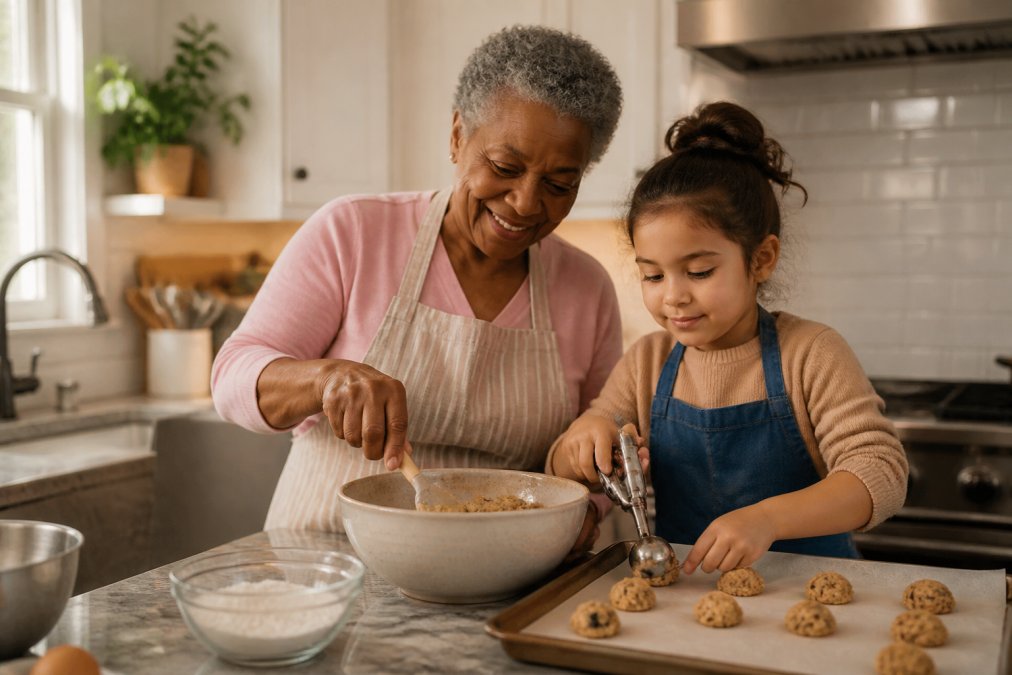
A good cookie mix removes the measuring and guesswork, leaving three tasks: bring ingredients to temperature, mix gently, and watch the oven.
Step 1: Bring Butter and Eggs to Room Temperature
Room temperature ingredients blend into a smooth batter instead of breaking into curds. Set butter and eggs on the counter 30 to 60 minutes ahead.
Step 2: Mix the Batter Until Just Combined
Stir until dry streaks disappear, then stop. Overmixing is the top reason cookies come out cake-like instead of chewy.
Step 3: Scoop, Bake, and Cool on Parchment Paper
Scoop uniform two-tablespoon portions two inches apart on a parchment paper-lined sheet; uniform size means uniform bake time.
Quick Breads, Muffins, and No-Bake Options
Quick breads and muffins use the same principle as drop cookies: mix wet into dry, stir until combined, and bake. No yeast, no rising time, no leavening agent gymnastics beyond baking powder or soda.
| Bake Type | Typical Prep | Oven Time | Difficulty |
|---|---|---|---|
| Drop cookies | 10-15 min | 10-13 min | Very easy |
| Muffins | 15 min | 18-22 min | Easy |
| Quick bread loaf | 15 min | 50-60 min | Easy |
| No-bake bars | 20 min | None | Very easy |
How to Store Pre Baked Cookies So They Stay Fresh
Knowing how to store pre baked cookies separates a cookie that tastes great on day one from one that still tastes great on day four. Two processes start the moment a cookie leaves the oven: moisture migration and starch retrogradation.
Match the Container to the Texture You Want
| Texture goal | Container | Add-in | Shelf life at room temp |
|---|---|---|---|
| Soft and chewy | Airtight tin or zip-top bag | One slice of sandwich bread | Up to 5 days |
| Crisp and snappy | Paper bag or loosely covered tin | Nothing | Up to 1 week |
| Cakey (muffins, teacakes) | Airtight container | Paper towel under the lid | Up to 3 days |
| Fudgy no-bake bars | Airtight container, parchment between layers | Nothing | Up to 5 days |
A bread slice in a soft-cookie tin releases moisture faster than the cookies lose it, keeping the crumb tender, swap it every other day. For crisp cookies, a loose cover lets steam escape so the surface stays dry and shatters.
Day-by-Day Texture Timeline
A drop cookie stored correctly follows a predictable arc:
- Day 1: Edges crisp, center soft, aroma at peak.
- Day 2: Moisture equalizes; the whole cookie is uniformly chewy.
- Day 3: Crumb firms slightly; flavor deepens as the vanilla and brown sugar notes meld.
- Day 4-5: Edges soften, center stays tender if the bread slice was refreshed.
- Day 6+: Starch retrogradation dominates; the cookie tastes stale even if it looks fine.
Freezing and Reviving
Freeze fully cooled cookies in a zip-top bag with parchment between layers, up to 3 months, and thaw in the bag so condensation forms on the bag, not the cookie. To revive a stale cookie, five seconds in the microwave softens the crumb; three minutes in a 300°F oven re-crisps the edges. Eat revived cookies the same day.
What Not to Do
Common Beginner Baking Mistakes and How to Fix Them
Most beginner failures trace to four causes: wrong temperature, too much mixing, wrong pan, or opening the oven door. Fix those and your success rate climbs fast.
- Cookies spread too flat: Butter was too warm, or the dough sat out too long. Chill the dough 20 minutes and bake on a cool sheet.
- Cookies didn't spread at all: Butter was too cold, or you added too much flour. Let the dough rest 10 minutes at room temperature.
- Dry, cake-like crumb: Overmixing. Stop when the last dry streak disappears.
- Burnt bottoms, raw centers: Dark pan or oven running hot. Switch to a light aluminum sheet and check your oven with a thermometer.
- Uneven batches: Scoops were different sizes. Use a measuring scoop or a scale.
Dietary Swaps and Cost Per Serving for Easy Bakes
Gluten-free and vegan swaps work best in recipes with fewer structural demands. Drop cookies and fudgy no-bake bars adapt well because they rely on fat and sugar for structure, not gluten networks. Yeasted breads and delicate layer cakes don't, save those for later.
1:1 Substitution Table for Easy Bakes
| Original | Swap | Ratio | Texture trade-off |
|---|---|---|---|
| All-purpose flour | Gluten-free 1:1 blend with xanthan gum | 1 cup : 1 cup | Slightly grittier crumb; rest dough 15 min before scooping |
| Butter | Plant butter, 80% fat | 1 cup : 1 cup | Same spread; check the label, tub spreads with under 70% fat cause flat cookies |
| Egg (binder) | Flax egg (1 tbsp ground flax + 3 tbsp warm water, rested 5 min) | 1 egg : 1 flax egg | Denser, chewier crumb; browns faster |
| Egg (moisture) | Mashed ripe banana | 1 egg : 1/4 cup | Adds banana flavor; reduce sugar by 1 tbsp per egg |
| White sugar | Coconut sugar | 1 cup : 1 cup | Darker color, caramel note, slightly drier crumb |
| Brown sugar | White sugar + 1 tbsp molasses per cup | 1 cup : 1 cup + 1 tbsp | Less moisture; cookies spread slightly less |
Two rules make swaps work: change one variable at a time so you can taste what each did, and expect a denser crumb from any egg replacer, flax eggs and banana don't whip air like a real egg, so the cookie is heavier.
Which Easy Bakes Tolerate Swaps Best
- Drop cookies: Excellent. Fat and sugar carry the structure.
- Fudgy no-bake bars: Excellent. No oven means no rise to lose.
- Muffins: Good. Expect a slightly denser dome.
- Quick bread loaves: Fair. Gluten-free versions often need an extra 5-10 minutes in the oven.
- Pound cake: Poor. The butter-and-egg ratio is the whole recipe.
Cost Per Serving
Conclusion: Start with the Easiest Thing to Bake
The easiest thing to bake is the one that forgives your timing, tools, and attention span. Drop cookies and quick breads do that; fancy laminated doughs don't.
Frequently Asked Questions
What is the most easiest thing to bake for a beginner?
Cookies from a premium mix are the most easiest thing to bake for a beginner. You skip measuring flour, sugar, and leavening agents. Lura's Kitchen mixes need just butter and eggs. In under 30 minutes you get 3 to 4 dozen cookies. No fancy equipment, no stress. Just mix, scoop, and bake. It is a foolproof start.
How do I store pre baked cookies to keep them fresh?
Let cookies cool completely on a wire rack. Store them in an airtight container at room temperature for up to 5 days. Add a slice of bread to keep them soft. For longer storage, freeze baked cookies in a zip-top bag for up to 3 months. Reheat in a 300°F oven for 5 minutes. This method works for any homemade cookie.
What beginner baking tools do I need for easy recipes?
You need a mixing bowl, whisk or wooden spoon, baking sheet, parchment paper, and measuring cups. A cookie scoop helps with uniform size. An oven thermometer ensures accurate temperature. These tools cover cookies, muffins, and quick breads. You do not need a stand mixer for most beginner recipes. Start with these basics and expand later.
Can I make easy bakes gluten-free or vegan?
Yes, many easy recipes have gluten-free and vegan swaps. For gluten-free, use a 1-to-1 gluten-free flour blend. For vegan, replace eggs with flax eggs and butter with plant-based butter. Lura's Kitchen offers a gluten-free teacake mix option. Always check labels and adjust bake times slightly. These swaps let everyone enjoy homemade treats.
The gap between wanting to bake and actually baking is usually a recipe that asks too much. Start with a mix that asks for butter and eggs, and you'll have warm cookies on the counter before the doubt sets in. Get started with Lura's Kitchen and share something homemade this week.